
BUTTOCK LIFT (GLUTEAL LIFT) IN DUBAI
A Flat Tummy Means Nothing If Your Buttocks Are Still Sagging.
Many patients come to me having already had a tummy tuck elsewhere. The abdomen looks great. But when they turn around, there’s still loose, sagging skin on the lower back and buttocks that nobody addressed. The front was fixed. The back was forgotten.
Others come after significant weight loss — through bariatric surgery, Mounjaro, Ozempic, or years of lifestyle change — with skin excess that wraps the entire lower body. The buttocks have deflated and dropped. The lower back has folds. And no matter how much weight they’ve lost, the back view still doesn’t reflect the transformation.
A Buttock Lift — also called a Gluteal Lift — addresses exactly this. It removes the excess skin, lifts and reshapes the buttock tissue, and restores a firmer, smoother, more proportionate posterior contour.
BUTTOCK LIFT
WHAT IS BUTTOCK LIFT? — And How Is It Different From a BBL?
This distinction is important because patients confuse the two all the time.
A Brazilian Butt Lift (BBL) adds volume to the buttocks using fat transfer. It’s for patients who want more projection, more shape, more curves. The buttocks aren’t necessarily sagging — they just need more.
A Buttock Lift is the opposite. It’s for patients who have too much — too much loose skin, too much sag, too much excess that’s dragging the buttocks down. The surgery removes that excess, lifts the remaining tissue, and tightens the contour. It doesn’t add volume. It restores position.
For some patients — particularly after massive weight loss where both excess skin and volume deflation are present — the two can be combined. But they’re separate procedures with separate goals, and understanding the difference helps you walk into your consultation knowing what you actually need.
Who Is This Procedure For?
Post-Weight-Loss Patients — Mounjaro, Ozempic, and Bariatric Surgery
With the rise of weight loss medications like Mounjaro and Ozempic, and the continued growth of bariatric surgery, more patients than ever are achieving significant, rapid weight loss. The medications and procedures work. But the skin doesn’t follow — not after losing 30, 40, 50 kilograms or more.
For these patients, the excess skin wraps the entire lower body — abdomen, flanks, lower back, and buttocks. The buttocks specifically tend to deflate and drop, leaving a flat, sagging posterior that no amount of training will fix.
In this group, a buttock lift is rarely done in isolation. It’s almost always part of a larger circumferential plan — either a full 360° Lower Body Lift (Belt Lipectomy) that addresses the abdomen, flanks, lower back, and buttocks all in one, or a Circumferential Tummy Tuck that combines the abdominal component with the posterior lift.
Patients Who Had a Previous Tummy Tuck
This is a very specific and underserved patient group — and I want to address it directly because I see them regularly.
You had a tummy tuck. The front looks great. But you still have persistent laxity on the lower back and your buttocks are still sagging. Nobody told you that a standard tummy tuck only addresses the front and sides — it doesn’t lift what’s behind you.
For these patients, a standalone buttock lift — addressing the posterior component specifically — is the right procedure. The previous tummy tuck scar is there, the abdominal work is done, and now we complete the picture from behind.

Types of Buttock Lift — Which One Do You Need?
Not all buttock lifts are the same. The right approach depends on where your skin excess sits, how much there is, and whether the abdomen has already been addressed.
Upper Buttock Lift
The incision sits along the upper buttock and lower back — hidden under underwear and swimwear waistbands. Skin is removed from above and the buttock tissue is lifted upward, restoring a higher, firmer posterior contour.
Best for: post-weight-loss patients with skin excess and sagging on the upper posterior, patients with lower back folds, and patients who have already had their abdomen addressed and need only the back completed. This is also the posterior component of a belt lipectomy when performed as part of a full circumferential lower body lift.
Banana Roll Lift (Inferior Gluteal Fold Excision)
The incision sits in the natural crease beneath the buttock — the infragluteal fold. Skin and fat excess at the lower buttock and upper thigh junction is removed, lifting the lower pole of the buttock and reducing the “banana roll” — that horizontal fold that sits just below the buttock crease.
Best for: patients with specific lower pole heaviness or descent, often younger patients or those with localized lower buttock sagging rather than full posterior excess. The scar sits in the natural crease and is well hidden in normal posture. This is a more targeted procedure than the upper buttock lift and is not typically used in massive weight-loss cases where the excess is more circumferential.
Belt Lipectomy (360° Lower Body Lift)
The circumferential approach — combining the upper buttock lift with the abdominal and flank components in one complete procedure. A single incision runs all the way around the lower torso, removing the entire skin excess belt and lifting the buttocks, outer thighs, and abdomen together.
Best for: post-bariatric and post-Mounjaro patients with significant circumferential skin excess. The most powerful approach for a complete lower body transformation — and the one that gives a result that looks right from every angle. Typically staged carefully for operative time and safety.
The right approach is decided during your consultation after a proper physical examination. I’ll assess the full extent of the skin excess, whether it’s upper, lower, or circumferential, and build the plan around your anatomy and your goals.

WHY CHOOSE DR. HARDIK GANATRA FOR BUTTOCK LIFT IN DUBAI
I treat the full circumference — not just the front.
A great lower body result looks right from every angle. Whether I’m performing a standalone posterior lift or a full belt lipectomy, I plan the approach as a complete unit so the transitions are smooth and nothing looks isolated or incomplete.
10+ years specializing in post-weight-loss body contouring.
Post-bariatric and post-weight-loss patients present a very specific surgical environment — the skin quality, tissue integrity, and extent of excess are all different from standard cases. I do this work regularly and have significant experience managing complex circumferential cases.
I’m honest about what needs to go all the way around.
If your skin excess is truly circumferential and a standalone buttock lift won’t give you a complete result — I’ll tell you that honestly. The goal is a result that looks right, not one that’s half finished.
I combine technology where it adds value.
Where residual fat needs contouring alongside skin removal, VASER Liposuction is used to refine the flanks and hip transition. Where skin tone needs extra help, J-Plasma (Renuvion) can be added. Everything is chosen based on your specific anatomy.
Post-surgery, you get a customized plan.
Every patient gets a recovery plan built around their procedure and their lifestyle. For patients who train, I’ll give you a specific return-to-exercise timeline — not a generic instruction sheet.

Are You a Good Candidate?
A Buttock Lift is the right procedure if:
- You’ve lost significant weight and are left with sagging, excess skin on the buttocks and lower back
- You’ve had a previous tummy tuck and still have persistent posterior laxity
- Your weight has been stable for at least 6–12 months
- You’re in good overall health and nutritionally optimized for surgery
- You’re not a smoker — or willing to stop well ahead of surgery
- You have realistic expectations about results and scarring
If you’re still actively losing weight — through bariatric surgery, Mounjaro, Ozempic, or lifestyle changes — wait. Operating before your weight has stabilized gives you a result that won’t hold. When you’ve reached your stable weight, come in.

What Happens Before Your Surgery
A full assessment of the posterior and circumferential extent.
I examine the full extent of the skin excess — buttocks, lower back, flanks, and abdomen — to determine whether a standalone posterior lift is sufficient or whether a circumferential approach is needed. If you’ve had a previous tummy tuck, I assess the existing scar and plan around it.
Nutritional optimization.
For post-bariatric patients especially — protein levels, vitamin stores, and overall nutritional status are assessed before surgery. Major skin removal places real demands on the body, and being properly prepared makes a significant difference to healing.
Medical clearance.
Routine bloodwork and any additional investigations needed — including cardiac clearance where indicated by your weight loss history or medications.
Clinical photos and measurements.
Standardized and fully confidential. Essential for planning and comparing results.
Full consent discussion.
Every risk, every realistic outcome, every aspect of recovery — including honest information about scarring — explained clearly before you sign anything.
Anesthesiologist meeting.
Every patient meets the anesthesiologist before the procedure. No exceptions.
What Is a Buttock Lift Surgery?
Step 1: Marking
Markings are made while you’re standing — mapping the skin to be removed, incision placement, and how the remaining tissue will be re-draped. For a belt lipectomy, this wraps around the full circumference of the lower torso. This stage is extensive and important — it’s where the entire surgical blueprint is set.
Step 2: VASER Liposuction (where indicated)
Where excess fat accompanies the loose skin — particularly in the flanks and hip transition zones — VASER Liposuction is performed first to refine the contour and reduce tension on the skin closure.
Step 3: Skin Excision and Tissue Elevation
Excess skin is removed along the planned incision lines. The remaining tissue is carefully lifted, re-draped upward, and secured to create a firmer, smoother buttock contour. This is where the lift happens — not just at the skin surface but at the tissue level underneath.
Step 4: Fat Grafting (where indicated)
Where volume restoration is part of the plan — to enhance projection alongside the lift — selective fat grafting can be performed using ultrasound guidance, with fat placed subcutaneously above the muscle only. This is always staged carefully based on blood supply and tissue healing.
Step 5: Closure and Compression
Incisions are closed in layers with fine sutures. Compression garments are applied immediately to support healing and maintain the new contour.

Recovery — What to Expect
- Days 1–3: Swelling, tightness, and discomfort. Compression garment worn full time. Short gentle walks encouraged from early on. Avoid sitting directly on the posterior incision.
- Weeks 1–2: Light movement and desk work. Avoid prolonged sitting or positions that put direct pressure on the posterior incision. Sleep on your front or side.
- Weeks 2–3: Most patients return to light daily activities.
- Weeks 4–6: Gradual return to the gym. Lower body work and anything that puts tension on the incisions stays off the table until cleared.
- Month 3: Final contour clear. Scars continue to mature and fade over 6–12 months.
Aftercare Includes:
- Compression garments for 4–6 weeks
- Lymphatic drainage sessions
- IV nutrition and peptide therapy to support healing
- Scar management — silicone therapy, taping, sun protection
- Regular follow-up visits

Can a Buttock Lift Be Combined With Other Procedures?
Yes — and for post-weight-loss patients especially, it almost always makes sense to think about the bigger picture. Common combinations include:
- 360° Lower Body Lift / Belt Lipectomy — for patients with full circumferential skin excess
- Tummy Tuck — where the abdominal and posterior components are addressed together
- Thigh Lift — for complete lower body contouring
- VASER Liposuction — for contouring of the flanks, hips, and lower back
- BBL (Fat Grafting) — staged after healing for patients wanting volume restoration alongside the lift
BUTTOCK LIFT
Before & After
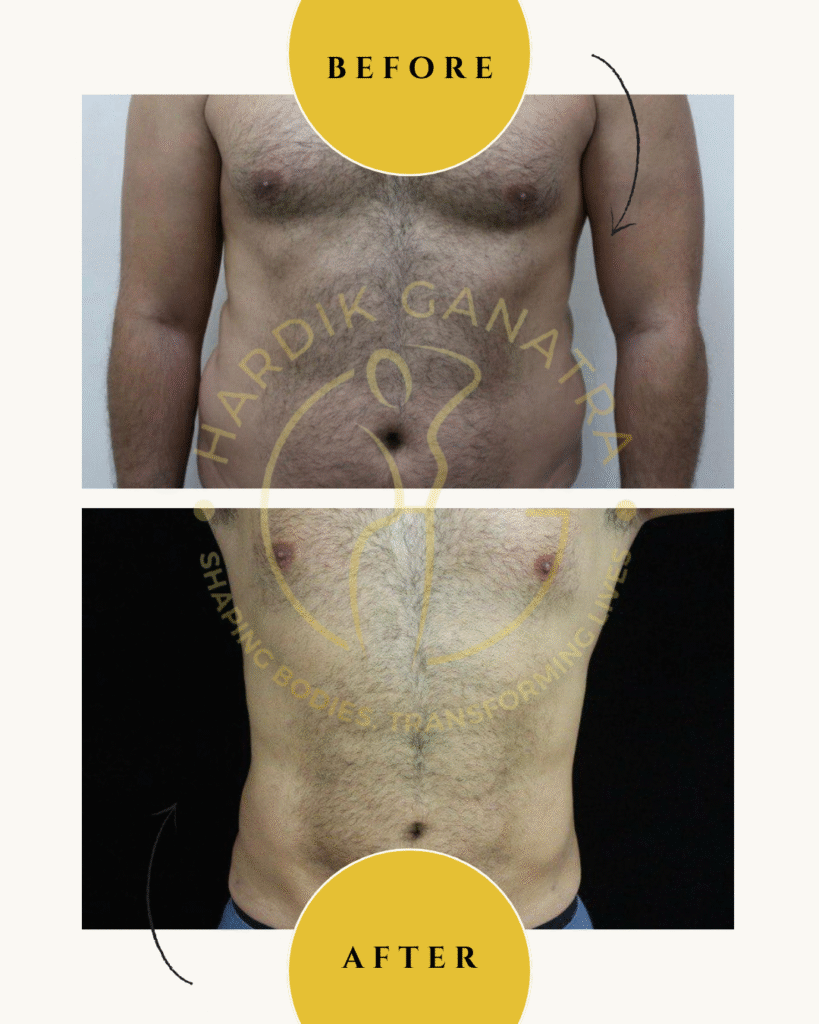
Each Buttock Lift performed by Dr. Hardik Ganatra showcases a refined, lifted, and proportionate result — never exaggerated.

What OUR Patients are saying ?
“For the first time in years, I love how my clothes fit.”
“After my weight loss journey, I felt proud — but the sagging skin around my hips and buttocks kept me from feeling truly confident. Dr. Ganatra explained every step of the buttock lift and made sure the results looked completely natural. The shape, the proportion, the balance — it’s exactly what I hoped for.”
— M.L., 37, United Kingdom
“It wasn’t just about curves; it was about confidence.”
“I had been hesitant about surgery for years, but the trust and attention to detail from Dr. Ganatra’s team made all the difference. The buttock lift gave me a smooth, lifted contour that looks and feels like my own body — only better. It’s incredible how much lighter and more confident I feel now.”
— A.K., 41, Dubai
BUTTOCK LIFT Dubai Frequently Asked Questions
1. What’s the difference between a buttock lift and a BBL?
A BBL adds volume using fat transfer — for patients who want more projection and curves. A buttock lift removes excess skin and lifts sagging tissue — for patients who have too much loose skin dragging the buttocks down. Different procedures, different goals. For some patients both are needed — but they’re typically staged, not combined in one session.
2. What are the different types of buttock lift?
There are three main approaches. The upper buttock lift removes skin from above and lifts the buttocks upward — best for post-weight-loss patients with upper posterior excess. The banana roll lift (inferior gluteal fold excision) removes skin from the crease beneath the buttock — best for localized lower pole descent in patients without circumferential excess. The belt lipectomy is the circumferential approach that addresses the abdomen, flanks, lower back, and buttocks all in one — best for post-bariatric patients with full lower body skin excess.
3. I already had a tummy tuck — can I still have a buttock lift?
Yes — and this is actually a very common scenario. A standard tummy tuck addresses the front and sides. If you still have posterior laxity and sagging buttocks, a standalone posterior buttock lift is the right next step. I’ll plan the approach around your existing scar.
4. Do I need a full belt lipectomy or just a posterior lift?
That depends on whether your skin excess is truly circumferential. If it wraps all the way around — abdomen, flanks, lower back, and buttocks — a belt lipectomy gives you the complete result. If it’s isolated to the posterior and you’ve already had your abdomen addressed, a standalone lift is sufficient. I’ll assess this properly during your consultation.
5. What is the banana roll and can it be fixed?
The banana roll is the horizontal fold of skin and fat that sits in the crease just below the buttock. It can make the lower buttock look heavy and drooping. An inferior gluteal fold excision removes this excess through an incision hidden in the natural crease — lifting the lower pole of the buttock and giving a cleaner transition to the thigh.
6. Can I have a BBL after a buttock lift?
Yes — commonly staged. After the lift has fully healed and blood supply is well established, ultrasound-guided fat transfer can be considered to enhance projection. Fat is placed subcutaneously, above the muscle only. Never intramuscular.
7. Will the scar be visible?
The upper buttock lift incision runs along the upper buttock and lower back — hidden under underwear and swimwear waistbands. The banana roll incision sits in the natural infragluteal crease. In a belt lipectomy, the scar extends around the full circumference at this level. Scars are long — but placed strategically, and they fade significantly over 6–12 months with proper management.
8. When do I need to wait before surgery?
Your weight needs to be stable for at least 6–12 months. For post-bariatric patients, nutritional status — particularly protein and vitamin levels — also needs to be optimized. I’ll guide you through the preparation process.
9. Will it treat cellulite or stretch marks?
Tightening can improve the appearance of dimpling but it’s not a cellulite treatment. Stretch marks within the skin that’s removed will be gone. Others may shift position but won’t disappear.
10. What about sensation or sitting after surgery?
Temporary reduced sensation over the upper buttock is common and usually resolves over months. Sitting is allowed with cushioning and short intervals early on — I’ll give you a step-by-step plan to increase tolerance safely as healing progresses.
11. Is it painful?
Manageable — tightness and soreness rather than significant pain. Modern pain management protocols handle the first few days comfortably.
12. How long do results last?
Long-lasting with stable weight and healthy habits. Significant weight fluctuations can affect the remaining skin over time — which is why weight stability before and after surgery matters.
13. How much does a buttock lift cost in Dubai?
Depends on the extent — standalone posterior lift vs banana roll excision vs full belt lipectomy — whether VASER or fat grafting is combined, and operating time. You’ll receive a personalized quote after your consultation.