
BREAST REDUCTION SURGERY IN DUBAI
Large Breasts Shouldn’t Come at the Cost of Your Comfort, Your Posture, or Your Quality of Life.
Back pain that never goes away. Shoulder grooves from bra straps. Skin rashes under the breast fold. Difficulty exercising, finding clothes, or simply standing straight. These are not vanity complaints — they are real, daily physical burdens that significantly affect quality of life.
Breast Reduction Surgery is one of the highest patient satisfaction procedures in plastic surgery. Not just because of how it looks — but because of how it feels. Most patients tell me it’s one of the best decisions they’ve ever made.
BREAST REDUCTION
WHAT IS A BREAST REDUCTION SURGERY
Breast Reduction — medically called Reduction Mammoplasty — removes excess glandular tissue, fat, and skin from overly large breasts, reducing size, lifting shape, and repositioning the nipple to a natural, proportionate position on the breast mound.
It is simultaneously a functional procedure and an aesthetic one. The physical relief from back pain, neck pain, shoulder grooves, and skin irritation is often immediate. The aesthetic transformation — smaller, lifted, better-proportioned breasts — develops over the weeks and months following surgery.
And unlike many procedures, breast reduction inherently includes a lift. The two go hand in hand — you can’t reduce without reshaping, and you can’t reshape without lifting.
Two Important Conditions Worth Knowing About
Gigantomastia — When Breasts Become Truly Oversized
Gigantomastia is a condition where the breasts grow excessively large — well beyond normal variation. It can cause severe physical symptoms: chronic back and neck pain, nerve compression, skin breakdown, and in extreme cases, difficulty breathing or moving normally. For these patients, breast reduction isn’t a cosmetic choice — it’s a medical necessity.
Surgery for gigantomastia is more complex than a standard breast reduction. The volume being removed is significantly greater, the planning needs to account for maintaining blood supply to the nipple over a longer distance, and in many cases a free nipple graft is the safest approach. I have experience managing these complex cases and will walk you through exactly what to expect during your consultation.
Juvenile (Adolescent) Breast Hypertrophy — When It Starts Too Early
Some young women experience disproportionate breast growth during puberty — rapidly developing breasts that become significantly larger than normal and cause physical and psychological distress at an age when they’re already navigating enough. This is called juvenile or adolescent breast hypertrophy.
The surgical principles are the same as adult breast reduction, but the timing requires careful thought. In most cases, I recommend waiting until breast growth has stabilized — usually by the late teens — before operating. In severe cases where the physical or psychological burden is significant, earlier intervention may be appropriate. This is a conversation we have openly during the consultation, including with the patient’s family where relevant.

The Techniques — Pedicles, Patterns, and What They Mean
This is the part of breast reduction that most websites skip over entirely — and I think patients deserve to understand it. A breast reduction involves two decisions: how the skin is removed (the pattern) and how the nipple keeps its blood supply (the pedicle). Both matter enormously for the result and for safety.
The Skin Removal Pattern — What Determines the Scar
- Vertical (“Lollipop”) Pattern — a circle around the areola plus a vertical line running down to the breast fold. Best for moderate reductions where the breast needs reshaping and lifting. Shorter scar and excellent results in the right patient.
- Inverted-T (“Anchor”) Pattern — a circle around the areola, a vertical line to the fold, and a horizontal line along the breast fold. The most common approach for larger reductions. More scar — but more control over shaping and symmetry, especially in significantly enlarged or drooping breasts. The pattern is chosen based on how much tissue needs to be removed and how much reshaping is needed — not from a preference.
The Pedicle — How the Nipple Stays Alive
The nipple and areola need a continuous blood supply throughout the procedure. The pedicle is the bridge of tissue that keeps them connected to their blood source while everything around them is removed and reshaped. Think of it like a bridge — the nipple sits on top, and the pedicle is the structure underneath keeping it alive.
- Superior Pedicle — blood supply comes from above the nipple. Good for moderate reductions where the nipple doesn’t need to travel far.
- Inferior Pedicle — blood supply comes from below the nipple. The most widely used approach globally. Very reliable blood supply and works well for larger reductions.
- Medial Pedicle — blood supply comes from the inner side of the breast. Excellent for maintaining nipple projection and sensation. My preferred approach in many cases — tends to give a very natural shape.
- Superior-Medial Pedicle — a combination of above and inner supply. Good reach, reliable, and increasingly popular for its aesthetic results.
- Free Nipple Graft — in gigantomastia cases where the nipple needs to travel a very long distance, the safest approach is to remove the nipple entirely, reduce the breast, and reattach the nipple as a graft in its new position. This sacrifices nipple sensation and breastfeeding ability — but it’s the safest option when the alternative is compromising blood supply during a long-distance move. I explain this openly when it applies.
The pedicle choice is made based on the size of the reduction, the distance the nipple needs to travel, your anatomy, and the shape we’re trying to achieve. There is no single best pedicle — it’s a clinical decision made specifically for your case.
The Internal Bra — Galaflex Mesh Support
One of the biggest challenges in breast reduction is long-term shape maintenance. Even a beautifully executed reduction can experience bottoming out over time — the breast tissue descends, the lower pole stretches, and the shape you had at 3 months looks different at 3 years.
The internal bra technique — using an absorbable mesh called Galaflex — addresses this directly.
At the time of breast reduction, a Galaflex mesh is placed internally to support the breast tissue in its new position — like a structural scaffold underneath the skin. As the mesh gradually absorbs over 18–24 months, it stimulates your body’s own collagen production, leaving behind a natural framework of supportive tissue that holds the breast shape long-term. Think of it as building internal scaffolding that your own body eventually takes over.
Who benefits most from the internal bra?
- Patients with very heavy or dense breast tissue
- Patients with significant skin laxity alongside tissue excess
- Patients with gigantomastia where remaining tissue weight is still significant
- Patients who want the best possible long-term shape maintenance
It adds some cost to the procedure — but for the right patient, the long-term benefit is significant. I’ll discuss whether it’s appropriate for your case during your consultation.
Why Choose Dr. Ganatra for Breast Reduction in Dubai?
10+ years of experience in aesthetic breast surgery.
Breast reduction is a technically demanding procedure. The pedicle choice, the skin pattern, the symmetry planning, the internal shaping — all require experience and judgment that develops over years of practice. I take every case seriously and plan every reduction individually.
I plan by proportion, not by cup size.
Cup sizes mean nothing clinically — they vary between brands and tell me nothing about your anatomy. I plan your reduction by measurements, by proportion to your frame, and by what you tell me you want to be able to do comfortably.
I offer the internal bra (Galaflex) technique.
For patients where long-term shape support is a priority, I offer the Galaflex internal bra as part of the procedure. This is not something every surgeon offers — and for the right patient, it makes a meaningful difference to how the result holds over time.
I’m experienced with complex and gigantomastia cases.
Very large reductions require a different level of planning — particularly around nipple blood supply and the decision between a pedicled nipple and a free nipple graft. I have specific experience managing these cases.
Full transparency about scarring.
Breast reduction involves real scars — and I won’t pretend otherwise. I’ll show you exactly where the scars will sit, explain how they mature, and give you a proactive scar management plan from day one.

Are You a Good Candidate?
Breast reduction is the right procedure if:
- You experience chronic back, neck, or shoulder pain from heavy breasts
- You have shoulder grooving from bra straps
- You have skin irritation or rashes in the breast fold
- Your breast size limits physical activity or affects posture
- You struggle to find clothes that fit properly
- Your weight is stable and you’re in good overall health
- You’re not a smoker — or willing to stop well ahead of surgery
If you’re planning future pregnancies, it’s worth discussing timing. Pregnancy after breast reduction is safe, but it can affect the result — including size changes and breastfeeding ability. I’ll have that conversation openly during your consultation.

What Happens Before Your Surgery
A thorough breast assessment.
I examine breast size, skin quality, ptosis, nipple position, and the distance the nipple needs to travel to its new position. This determines the pattern, the pedicle choice, and whether Galaflex is appropriate.
A measurements-based plan.
I plan the reduction by your chest measurements, your frame, and your goals — not by a cup size target. We discuss what you want to be, I tell you what’s safely achievable, and we agree on a plan together.
Medical clearance.
Routine bloodwork and any additional investigations needed based on your history.
Mammogram or breast imaging (where indicated).
For patients of screening age or with relevant breast history, imaging before surgery is important for baseline comparison afterward.
Clinical photos and measurements.
Standardized and fully confidential. Essential for planning and comparing results.
Full consent discussion.
Every technique option, every risk, every realistic outcome — including honest information about scarring, breastfeeding, and nipple sensation — explained clearly before you sign anything.
Anesthesiologist meeting.
Every patient meets the anesthesiologist before the procedure. No exceptions.
HOW THE PROCEDURE IS PERFORMED
Step 1: Marking
Markings are made while you’re standing — new nipple position, skin pattern, reduction zones, and symmetry reference points. A great result starts with accurate, careful marking.
Step 2: Tissue Removal and Reshaping
Under general anaesthesia, excess glandular tissue, fat, and skin are removed according to the planned pattern. The remaining breast tissue is reshaped and secured into its new position — creating the internal breast mound before the skin is closed.
Step 3: Internal Bra Placement (where indicated)
Where Galaflex mesh support is planned, the mesh is placed at this stage to provide internal scaffolding for the reshaped breast mound — supporting the tissue in its new position while stimulating long-term collagen formation.
Step 4: Nipple and Areola Repositioning
The nipple-areola complex is elevated to its new position on the breast mound — maintaining blood supply through the chosen pedicle throughout. The areola can be reduced in size at the same time if needed.
Step 5: Closure
Incisions are closed in layers with fine sutures. A surgical support bra is applied immediately to maintain shape and reduce swelling.

Recovery — What to Expect
- Days 1–3: Mild soreness and tightness. Rest with limited arm movement. Surgical support bra worn full time.
- Week 1: Return to light daily activities. Avoid lifting or straining.
- Weeks 2–3: Non-dissolvable stitches removed if used. Swelling continues to subside.
- Weeks 4–6: Resume normal activities and light exercise. Upper body work resumes gradually.
- Month 3 onwards: Breasts settle into final shape and softness. Scars continue to mature over 12–18 months.
Aftercare includes:
- Surgical support bra for 4–6 weeks
- Scar management — silicone therapy and optional laser treatments
- Lymphatic drainage sessions to reduce swelling
- Regular follow-ups to monitor healing, symmetry, and shape
- Removed tissue sent for pathology — routine analysis to check for unexpected findings
Can Breast Reduction Be Combined With Other Procedures?
Yes — common combinations include:
- Liposuction of axillary tail and bra roll — for fullness extending into the armpit and side of the chest
- Tummy Tuck — for patients addressing multiple areas in one plan
- Mommy Makeover — for complete post-pregnancy restoration
- VASER Liposuction — for enhanced contouring of flanks or abdomen alongside the reduction

BREAST REDUCTION
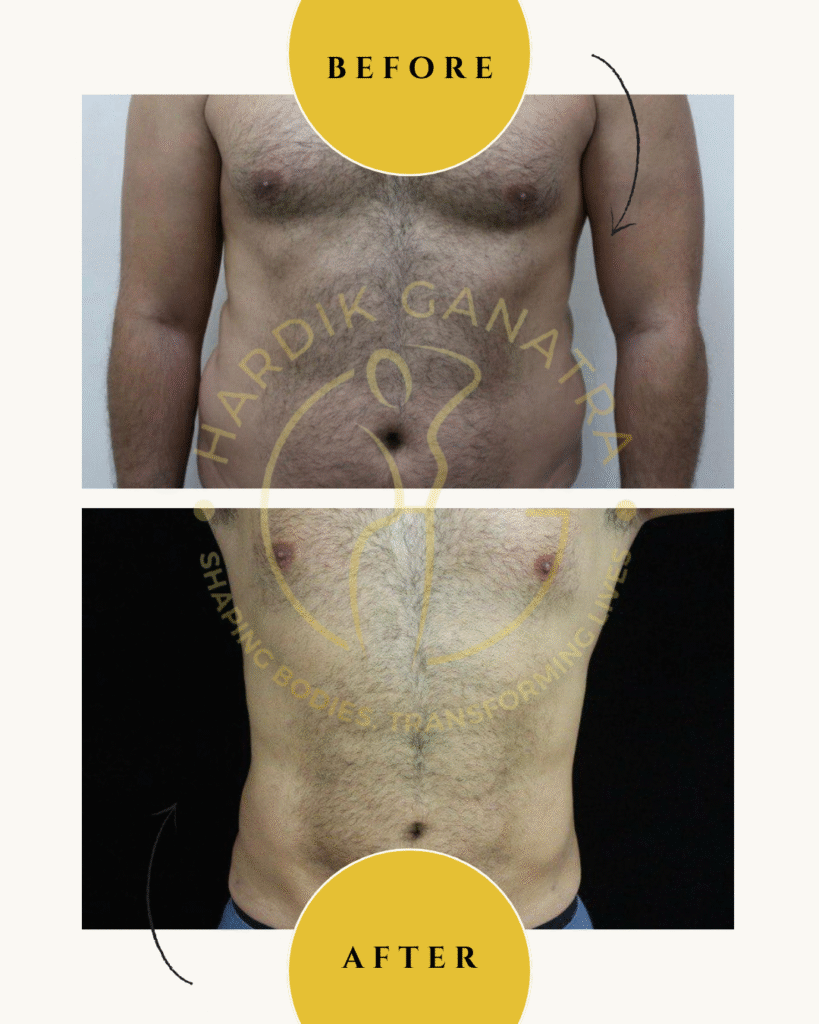
Before & After
Each Breast Reduction performed by Dr. Hardik Ganatra demonstrates improved comfort, balance, and self-confidence.

What OUR Patients are saying ?
“So happy with the results”
“I used to struggle with neck pain and couldn’t find clothes that fit properly. After my surgery with Dr. Hardik, I feel comfortable, confident, and pain-free. The results look natural and balanced.”
— P.N., 34, Dubai
“Finally confident in my own skin.”
“I hesitated for years before deciding on breast reduction. Dr. Hardik made the process smooth and reassuring. My posture improved, and I feel like a new person.”
— R.A., 29, India
BREAST REDUCTION Dubai Frequently Asked Questions
1. What is breast reduction surgery?
A surgery that removes excess breast tissue, fat, and skin to reduce size and improve shape — usually relieving back, neck, and shoulder pain, skin rashes, and bra-strap grooves. It inherently includes a lift and nipple repositioning.
2. Who is a good candidate?
Women with symptomatic heavy breasts — pain, posture issues, skin irritation, activity limitations, or difficulty finding clothes. You should be healthy, near a stable weight, and have realistic goals. Age is not a barrier — both younger patients with juvenile hypertrophy and older patients can benefit significantly.
3. Will it also lift my breasts?
Yes — reduction and lift go hand in hand. You can’t reduce without reshaping, and you can’t reshape without lifting. The nipple is repositioned to a natural height on the breast mound as part of the same procedure.
4. What cup size will I be after surgery?
Cup sizes vary by brand and mean nothing clinically. We plan by measurements and proportions, not labels. Tell me your desired look and I’ll match it to your anatomy safely — giving you a realistic picture of what’s achievable.
5. What techniques are used?
The two most common skin patterns are the vertical (lollipop) and the inverted-T (anchor). Internally, the nipple is kept on a blood-supply pedicle — superior, inferior, medial, or superior-medial — chosen based on the size of the reduction and your anatomy. In gigantomastia cases, a free nipple graft may be the safest approach.
6. What is the internal bra and do I need it?
The internal bra uses Galaflex absorbable mesh placed during surgery to support the breast tissue in its new position long-term. As the mesh absorbs over 18–24 months, it stimulates collagen formation that maintains the shape. Most beneficial for patients with heavy or dense tissue, significant laxity, or gigantomastia. I’ll discuss whether it’s appropriate for your case.
7. Where are the scars?
Around the areola, a vertical line to the breast fold, and in larger reductions, a horizontal line along the fold (the anchor pattern). Scars are placed as discreetly as possible and typically fade significantly over 12 months with proper care.
8. Will my nipples be moved or resized?
Yes — the nipple-areola complex is elevated to a natural position on the new breast mound and can be reduced in diameter if enlarged.
9. What about nipple sensation?
Most patients keep meaningful sensation, but temporary changes are very common. A small percentage experience reduced or, rarely, increased sensitivity long-term. The pedicle choice directly affects sensation preservation — I plan for this specifically.
10. Can I breastfeed after a reduction?
Many patients can — particularly those who have an inferior or medial pedicle where the ductal connections are preserved. Breastfeeding is less predictable after a free nipple graft. If future pregnancies are planned, discuss timing with me before proceeding.
11. Will it help my back and neck pain?
In the vast majority of cases — yes, significantly. Most patients report immediate relief of back, neck, and shoulder discomfort, improved posture, and better exercise tolerance. For patients with gigantomastia, the relief can be life-changing.
12. What is gigantomastia?
A condition where the breasts grow excessively large — causing severe physical symptoms including chronic pain, nerve compression, and skin breakdown. Surgery for gigantomastia is more complex than standard reduction and may require a free nipple graft for safety. I have specific experience managing these cases.
13. What is juvenile breast hypertrophy?
Disproportionate breast growth during puberty that causes significant physical and psychological distress. In most cases I recommend waiting until growth has stabilized before operating — but in severe cases, earlier intervention may be appropriate. This is discussed openly and sensitively during the consultation.
14. Is breast reduction safe?
In qualified hands and an accredited facility — yes. Safety includes careful pedicle planning for blood supply to the nipple, VTE prevention, meticulous control of bleeding, and sensible operative times. The risks increase in gigantomastia cases, which is why experience matters.
15. What are the risks?
Bleeding, infection, delayed wound healing (particularly at the T-junction in anchor patterns), seroma, asymmetry, fat necrosis, altered nipple sensation, and in rare cases partial or total nipple loss. All discussed in detail during your consent.
16. Will tissue be sent for pathology?
Yes — removed breast tissue is routinely sent for pathological analysis. This is standard practice and occasionally reveals unexpected findings that are important to know about.
17. What if my breasts are uneven to begin with?
Mild asymmetry is extremely common. I plan reductions asymmetrically to improve balance — removing different amounts from each side where needed. Very small differences may still remain, as perfect symmetry is not a realistic goal in any patient.
18. Can breast reduction be combined with liposuction?
Yes — axillary tail and bra roll liposuction is commonly combined when there is fullness extending into the armpit and side of the chest. Combination plans are individualized for safety and recovery.
19. How should I prepare?
Stop smoking, optimize nutrition and protein intake, pause certain medications and supplements as advised, arrange help at home for the first 48–72 hours, and bring your support bras to surgery as instructed.
20. Will it affect mammograms?
Always tell your radiology team you’ve had a breast reduction so they can interpret images appropriately. Routine screening should continue as normal.
21. How long do results last?
Long-lasting — particularly with stable weight and good bra support. Natural aging, pregnancies, and significant weight changes will still affect size and shape over time. The Galaflex internal bra technique improves long-term shape maintenance for suitable patients.
22. What does breast reduction cost in Dubai?
Fees depend on the technique, volume of tissue removed, whether Galaflex internal bra is included, hospital and anaesthesia time, and aftercare. You’ll receive a personalized quotation after consultation.