
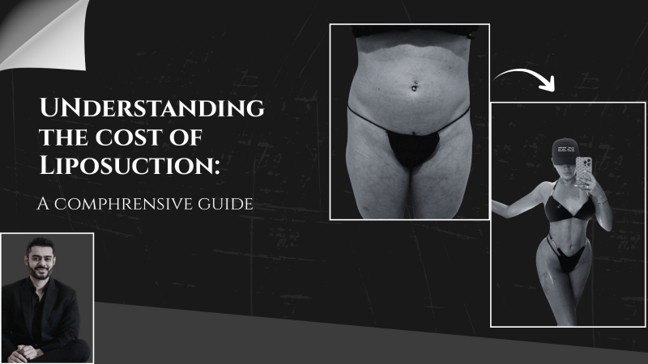
Cost of Liposuction in Dubai (2026): Prices for VASER, Lipo 360, Chin, Arms & More
A clear, honest guide to what liposuction costs, why quotations differ, and what you should actually compare.
AT A GLANCE
Typical range: AED 12,000-50,000 (about USD 3,300-13,600) for the
procedures listed in this guide
Best for: Patients comparing liposuction prices in Dubai
Reading time: Approximately 6 minutes
Important: A consultation is still required for an accurate quotation
How much does liposuction cost in Dubai?
One of the first questions almost every patient asks me is: “Doctor, how much does liposuction cost in Dubai?”
It is a completely fair question. You want to know whether the treatment fits your budget before spending an hour discussing cannulas, compression garments and skin quality.
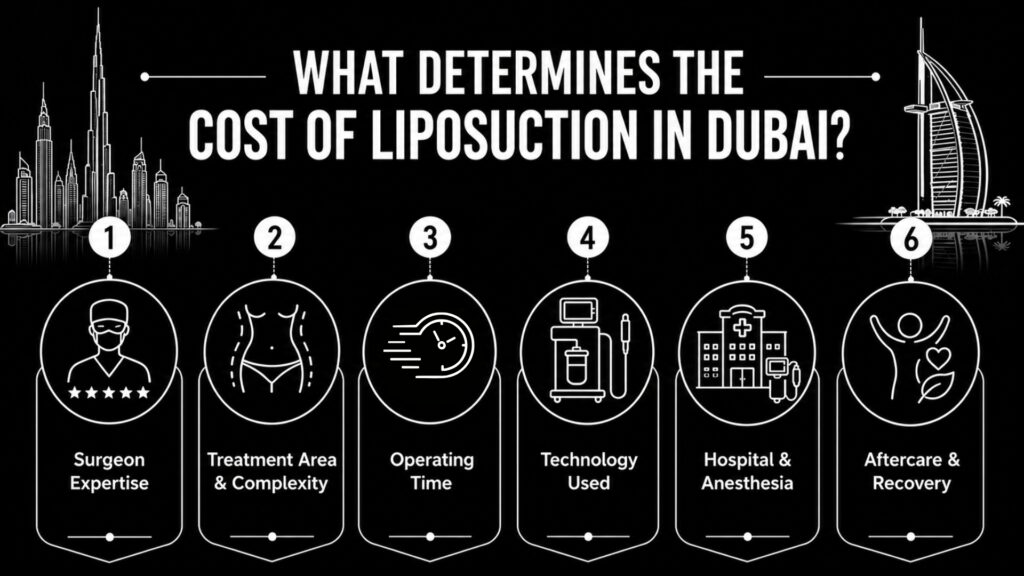
The honest answer is that liposuction does not have one fixed price. A small double-chin procedure and a full VASER Lipo 360 are both called liposuction, but they are not remotely the same operation. The treatment area, operating time, anesthesia, hospital costs, technology, skin quality and whether this is your first surgery or a revision all affect the final quotation.
QUICK ANSWER
In Dubai, the procedures in this guide generally range from approximately AED 12,000 to AED 50,000 (around USD 3,300 to USD 13,600). Larger combination procedures, complex revision cases or additional fat transfer may cost more.
Liposuction cost in Dubai by treatment area
|
Procedure / area
|
Approximate AED
|
Approximate USD
|
|---|---|---|
|
Double chin liposuction
|
||
|
Face and neck liposuction
|
AED 22,000-25,000
|
USD 6,000-6,800
|
|
Face and neck liposuction + J-Plasma
|
AED 25,000-30,000
|
USD 6,800-8,200
|
|
VASER arm liposuction
|
AED 25,000-30,000
|
USD 6,800-8,200
|
|
Arm liposuction + J-Plasma
|
AED 30,000-35,000
|
USD 8,200-9,500
|
|
VASER back liposuction
|
AED 25,000-30,000
|
USD 6,800-8,200
|
|
Back liposuction + J-Plasma
|
AED 30,000-35,000
|
USD 8,200-9,500
|
|
Thigh liposuction
|
AED 30,000-40,000
|
USD 8,200-10,900
|
|
VASER Lipo 360
|
AED 38,000-45,000
|
USD 10,300-12,300
|
|
Lipo 360 + J-Plasma
|
AED 40,000-50,000
|
USD 10,900-13,600
|
Price note: These are approximate planning ranges, not fixed quotations. Your written quotation should clarify the exact surgical plan, inclusions and any applicable VAT
Why can two liposuction quotations look completely different?
This is where patients understandably get confused. Two clinics may both write “abdominal liposuction”
on the quotation, yet one price may be dramatically higher.
But the name of the procedure tells you very little about the work involved. One plan may be a straightforward, small-area procedure under local anesthesia. Another may involve VASER, powerassisted liposuction, detailed sculpting, treatment of the flanks and back, general anesthesia, an overnight hospital stay, garments, foams and structured aftercare.
Both quotations may technically say “liposuction.” They are not the same operation. Comparing only the final number is a little like comparing two hotel rooms without checking the city, the room category or whether one of them is actually a tent.
SURGEON'S NOTE
Do not ask only, “How much fat will you remove?” The number of litres is not a quality score. Shape, symmetry, transition zones, skin behaviour and safety matter far more than chasing a dramatic volume.
What affects the cost of liposuction?
|
Factor
|
Why it changes the price
|
|---|---|
|
Size and number of areas
|
|
|
Operating time
|
More extensive sculpting and careful blending require longer theatre time
|
|
Type of anesthesia
|
A small procedure may be suitable for local anesthesia or sedation; larger
procedures usually require general anesthesia.
|
|
Hospital and facility fees
|
Accredited operating rooms, nursing, recovery care and overnight stay add to the
total cost.
|
|
Technology used
|
VASER, PAL/MicroAire and J-Plasma are different tools with different
disposables, equipment and operating-time requirements.
|
|
Skin quality
|
Good skin may retract well after fat removal. Loose skin may require J-Plasma, a
mini tummy tuck or formal skin excision.
|
|
Primary versus revision
surgery
|
Revision liposuction is usually more complex because previous surgery can leave
scar tissue, uneven fat layers, adhesions or over-suctioned areas.
|
|
Fat grafting or combination
surgery
|
Adding fat transfer, gynecomastia surgery, tummy tuck or another bodycontouring procedure changes the plan and price.
|
A quick guide to the most-searched procedures
Double chin liposuction cost in Dubai
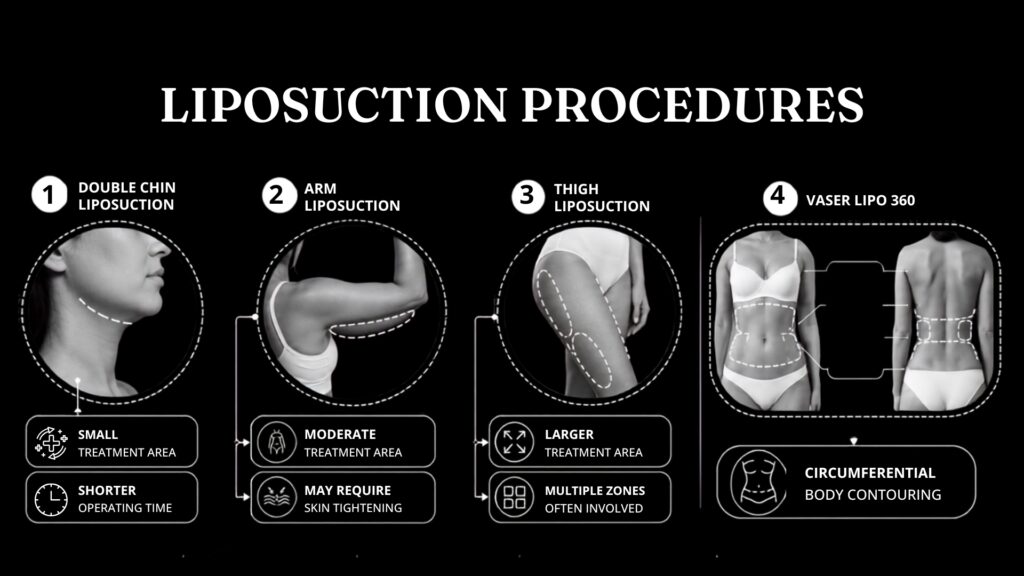
Double chin liposuction usually costs around AED 12,000-20,000 (USD 3,300-5,500). It may be performed as a focused procedure, but the price changes when the treatment extends into the jawline and neck or when skin tightening is added.
The key question is not simply whether there is fat under the chin. We also need to assess the skin, the neck anatomy and whether the concern is actually caused by fat, loose skin, muscle bands or a combination.
Arm liposuction cost in Dubai
VASER arm liposuction is approximately AED 25,000-30,000 (USD 6,800-8,200). When J-Plasma is
added for selected patients with mild-to-moderate skin laxity, the range is approximately AED 30,000-
35,000 (USD 8,200-9,500).
Arms are less forgiving than many patients expect. Smoothness matters, the transition into the shoulder
and axilla matters, and poor skin quality can limit the result. Removing more fat is not automatically
better.
Back liposuction cost in Dubai
VASER back liposuction generally ranges from AED 25,000-30,000 (USD 6,800-8,200), while back
liposuction with J-Plasma is approximately AED 30,000-35,000 (USD 8,200-9,500).
The back is often divided into upper, middle and lower zones. Treating only one roll may be less
extensive than contouring the full back and blending it into the waist. This is why phrases such as “back
lipo” can mean very different things on different quotations
Thigh liposuction cost in Dubai
Thigh liposuction is approximately AED 30,000-40,000 (USD 8,200-10,900), depending on whether the
plan includes the inner thighs, outer thighs, knees, banana rolls or multiple zones.
The thighs require conservative, even contouring. Skin quality and cellulite also need to be discussed
honestly because liposuction removes fat; it does not reliably erase cellulite or significantly loose skin.
VASER Lipo 360 cost in Dubai
VASER Lipo 360 generally costs approximately AED 38,000-45,000 (USD 10,300-12,300). When JPlasma is added, the range is approximately AED 40,000-50,000 (USD 10,900-13,600).
Lipo 360 is not simply “a little abdomen and a little back.” It usually means circumferential contouring of
the abdomen, flanks, waist and back so that the body is treated as one connected shape. That takes
more planning, positioning, operating time and postoperative care.
Does VASER liposuction cost more than traditional liposuction?
Often, yes. VASER uses ultrasound energy to help emulsify fat before it is removed. In experienced hands, it can be particularly useful for detailed contouring, fibrous areas and selected revision cases.
But technology should never become theatre. A machine does not create the result by itself. The plan, the surgeon’s judgment and how the tissue is handled still matter more than the logo on the device.
Learn more about VASER liposuction in Dubai and high-definition liposuction.
Does J-Plasma replace a tummy tuck?
No. J-Plasma can be a useful addition for selected patients who need fat removal and have mild-tomoderate skin laxity. It can improve skin contraction, but it cannot remove a large apron of loose skin or repair significant muscle separation.
PLAIN-SPEAKING VERSION
J-Plasma is useful technology, but it is not a tummy tuck wearing a clever suit. When skin excess is significant, an excisional procedure may provide the more honest and predictable solution.
Read more about J-Plasma skin tightening and tummy tuck surgery.
Why revision liposuction often costs more
Revision liposuction is rarely just “doing the same surgery again.” Previous fat removal can change the normal tissue planes and leave fibrosis, adhesions, dents, residual bulges or asymmetry.
Correction may require a combination of scar-tissue release, conservative fat removal, fat grafting and skin tightening. It also takes more time and restraint. In revision work, knowing when to stop is as important as knowing what to do.
What should a liposuction quotation include?
A quotation should be clear enough that you understand what you are paying for. Before comparing prices, ask whether the following are included:
- The exact areas to be treated
- Surgeon’s fee
- Hospital or operating-facility charges
- Anesthesia and anesthesiologist’s fee
- VASER, PAL or J-Plasma, when planned
- Overnight stay, if required
- Compression garment and foam boards
- Medication and routine postoperative follow-ups
- Lymphatic drainage or other aftercare, if included
- Any applicable VAT
The cheapest quotation is not always missing something, and the most expensive quotation is not automatically the best. The point is to compare the actual plan rather than comparing two numbers in isolation.
When liposuction is not the right answer
Sometimes the most useful part of a consultation is being told not to have liposuction.
Liposuction is designed to contour localized fat. It is not a substitute for weight loss, and it cannot reliably correct major skin excess or significant abdominal muscle separation. A patient with loose abdominal skin after pregnancy or major weight loss may need a tummy tuck. A patient expecting a large drop on the weighing scale may need a different plan entirely.
MY RULE
In body contouring, skin quality is half the result. If the skin cannot adapt to the new shape, removing more fat may make the problem more visible rather than less.
Is cheap liposuction in Dubai a good idea?
Everyone has a budget, and there is nothing wrong with discussing it openly. But surgery is not the place
to chase a bargain without understanding the trade-off.
A significantly lower price may be perfectly legitimate, or it may reflect a smaller treatment plan, fewer
inclusions, a different facility, less operating time or limited aftercare. Ask questions. A reputable surgeon
should be comfortable explaining exactly what is and is not included.
The expensive part of a poor result is not always the first surgery. It can be the revision, the time away
from work and the emotional cost of going through the process again.
Frequently asked questions
How much does liposuction cost in Dubai?
How much does Lipo 360 cost in Dubai?
How much does double chin liposuction cost in Dubai?
Can I get an exact liposuction price from photographs?
Is liposuction covered by insurance?
Can several areas be treated together?
Does the price include J-Plasma?
How do I choose a surgeon for liposuction in Dubai?
The bottom line
The cost of liposuction in Dubai depends on much more than the name of the area. A well-planned procedure considers the whole silhouette, the quality of the skin, the safest surgical setting and the aftercare needed to protect the result.
Use the price table as a realistic starting point, not a substitute for a consultation. The best quotation is not necessarily the lowest or the highest. It is the one that clearly explains the right operation for your body, what is included and what result is realistically achievable.