Fixing Botched Lipo: What Actually Went Wrong — and How to Fix It
Congratulations on Your Weight Loss Journey
If you’re reading this, you probably already know something doesn’t look right. Maybe you have lumps. Maybe one side looks completely different from the other. Maybe your skin hangs where fat used to be. Maybe you went in hoping for a flat stomach and came out with dents, hardness, and a result that’s made you more self-conscious than before. I see patients like you in my clinic regularly. And the first thing I tell them is this: you’re not imagining it, you’re not being dramatic, and in most cases something can be done about it.
But here’s what’s equally important: “botched lipo” is not one problem. It’s a label that covers a dozen different issues, each with a different solution. The biggest mistake patients make and frankly, some surgeons too is assuming that bad liposuction results always mean “do more liposuction.” That’s often exactly the wrong answer.
1. Still looks full — the fat wasn't removed properly
This is the most straightforward complaint: the area still looks the same, or the fat removal was uneven and poorly planned for your frame. Sometimes it’s too conservative. Sometimes the surgeon didn’t account for your skin quality or the volume of tissue involved.
If your skin is still in good shape and the main issue is residual fat, revision liposuction may be the right move. But only if the tissues are soft enough, the anatomy is clear, and your skin still has the elasticity to redrape properly. This is where
If your skin is still in good shape and the main issue is residual fat, revision liposuction may be the right move but only when the tissue is soft, the anatomy is workable, and your skin still has elasticity. This is what I assess during a revision consultation before recommending anything. You can read more about the process on my Revision Liposuction Dubai page.
2. Looks scooped out or hollow — too much fat was removed
The opposite problem. You went in wanting definition and came out looking carved, skeletal, or stuck-down. The abdomen looks glued to the muscle. The flanks look sharp instead of smooth. The transition is broken.
This problem doesn’t need more liposuction it usually needs volume restoration. Fat grafting, scar release, subcision, or a combination. The goal isn’t just to “fill” dents; it’s to restore natural transitions and soften harsh edges. This kind of correction is very different from primary HD liposuction it requires a surgeon who understands post-liposuction deformity, not just fat removal.
3. Hard, lumpy, and stuck down — fibrosis and scar tissue
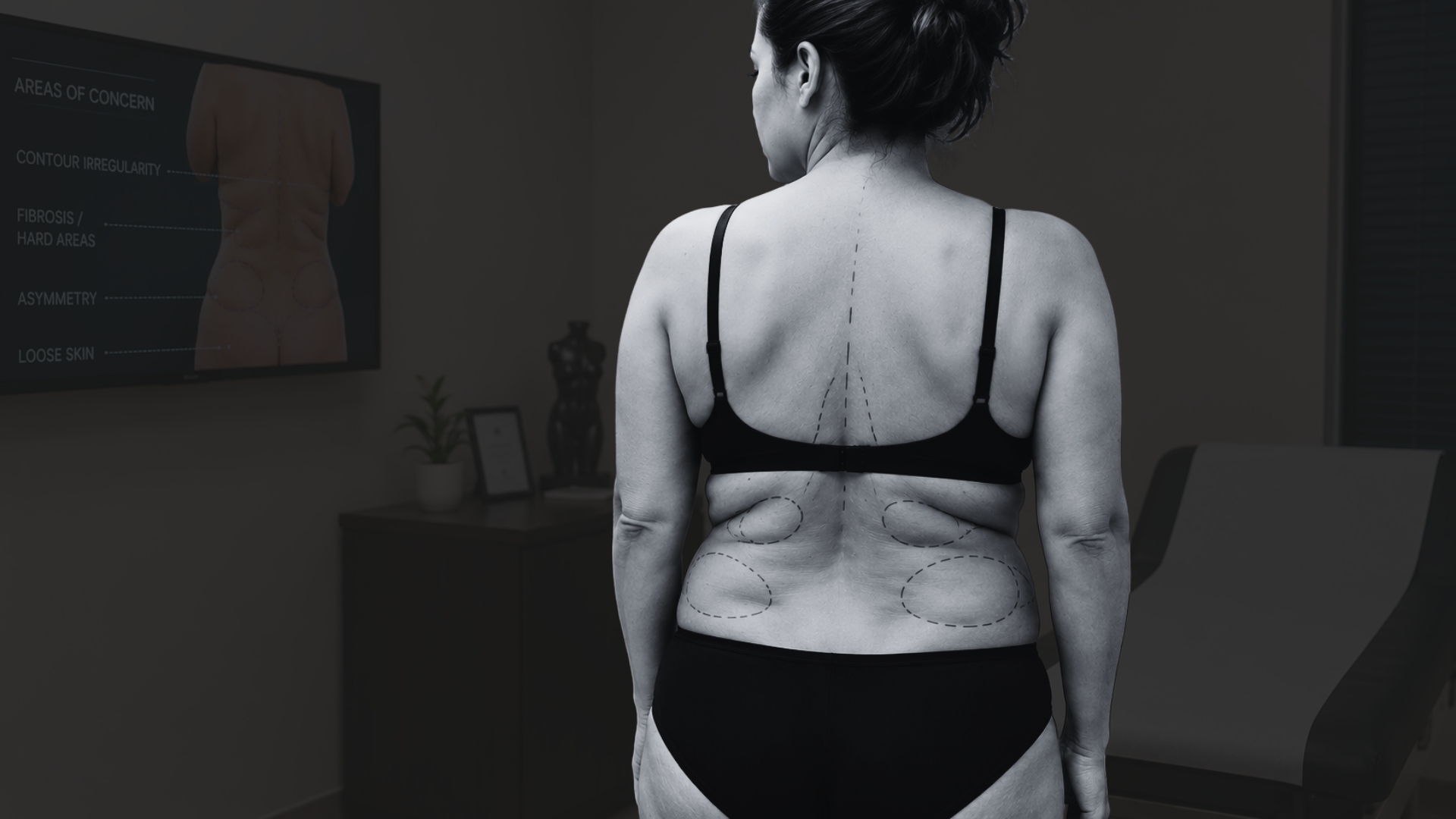
One of the most common complaints I hear: ‘It feels hard,’ ‘There are thick bands under my skin,’ ‘Certain areas feel glued to my muscle.’ Patients call all of this fibrosis, and sometimes they’re right. But not every lump is true fibrosis it could be swelling, residual fat, an adhesion, or a contour irregularity masquerading as something else.
Milder cases may improve with compression and lymphatic work over time. More established cases need scar release, subcision, selective revision liposuction, or fat grafting. Scarred tissue needs strategy, not just force.
4. Loose skin after liposuction — the conversation nobody had with you
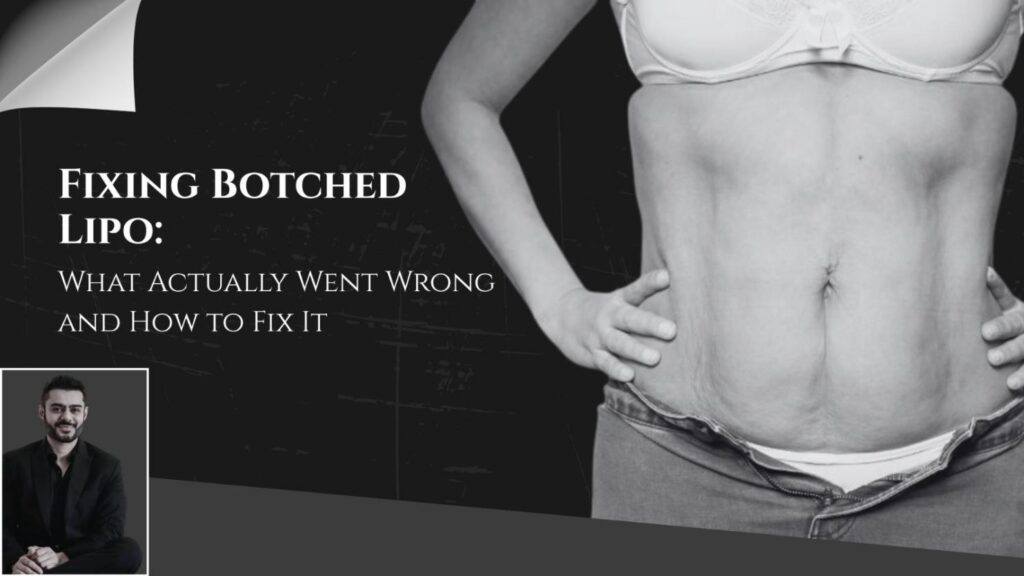
This is the most common reason patients feel their liposuction “went wrong” when in reality, liposuction alone was never going to solve the problem to begin with. The fat was removed, but the skin didn’t retract. Now you have wrinkling, rippling, hanging tissue, or creasing when you bend forward. You traded one problem for another.
For mild laxity, energy-based skin tightening like J-Plasma / Renuvion can help it’s a tool I use regularly as a bridge for patients not quite ready for excisional surgery. But when the loose skin is significant, no device is going to reliably remove excess. That’s when surgery is the honest answer.
Lower abdominal loose skin → Tummy Tuck in Dubai | Upper abdominal loose skin → Reverse Tummy Tuck
5. Asymmetry and uneven results
Not every botched result is dramatic. Sometimes it’s subtle: one side smoother than the other, one hip that dips more, visible grooves or ridges across the abdomen when the light hits a certain way. You notice it. You obsess over it. And you can’t un-see it.
Correction depends on the pattern. One side may need selective revision liposuction. The other may need fat grafting. Tethering may need scar release. Loose skin on one side may need tightening or excision. A good revision plan addresses the cause, not just the appearance.
6. Fluid pockets, burns, and other complications
Seromas fluid collections that form after surgery are manageable early. Left untreated, they can develop a fibrous capsule and create a persistent lump or deformity that won’t go away with drainage alone. At that stage, surgical excision of the capsule is often the definitive answer.
Burns and thermal injuries from energy devices are a different beast entirely. In the acute phase, the focus is wound healing. Later, depending on depth and scarring, you may need scar revision, fat grafting, excision of damaged tissue, or staged contour reconstruction. These cases are complex and need to be staged properly.
The most important step: getting the right diagnosis
Revision body contouring is fundamentally different from primary liposuction. The first operation is about removing fat safely and artistically. The second is about solving a deformity. That requires a completely different mindset.
Here’s how I think about it:
Problem | Solution |
Residual fat | Revision liposuction |
Hollows / over-resection | Fat grafting |
Fibrosis and tethering | Scar release, subcision, selective revision |
Loose skin | Skin tightening or excision |
Lower abdominal excess skin | Tummy tuck surgery |
Upper abdominal excess skin | Reverse tummy tuck |
Encapsulated seroma | Capsule excision |
Burn scars | Staged reconstruction or scar revision |
When should revision surgery happen?
Not immediately. Most tissues need time to soften and declare themselves. In the majority of patients, I recommend waiting at least 6 months before major corrective surgery swelling needs to settle, scar tissue needs to mature, and the true picture needs to emerge. Operating too early makes both the judgment and the surgery harder. Patience here is not passivity it’s strategy.
Final thoughts
Fixing botched lipo is rarely about doing more lipo. It’s about understanding what actually went wrong, then choosing the right tool to fix it. Some patients need refinement. Some need reconstruction. Some need volume restored. Some need a tummy tuck. And some simply need honesty that liposuction alone was never going to solve loose skin or poor tissue quality in the first place.
The best revision results come from a surgeon who understands not just liposuction, but what happens after it goes wrong the deformities, the scar behaviour, the skin, and the full spectrum of body contouring correction available in plastic surgery Dubai today. If you’re unhappy with your current results and want an honest assessment of what can be done, book a consultation here.
Related: Revision Liposuction Dubai | VASER Liposuction Dubai | Tummy Tuck in Dubai | J-Plasma / Renuvion | Brazilian Butt Lift Dubai | Mommy Makeover Dubai | Body Contouring Dubai | About Dr. Ganatra
About the Author
Dr. Hardik Ganatra | Body Contouring Specialist | Plastic Surgeon | Dubai, UAE. 10+ years experience. Specialties: High Definition Liposuction, Tummy Tuck, Body Contouring for weight loss patients, Brazilian Butt Lift. Philosophy: every transformation should be life-changing, artistic, and natural. Works with patients regionally and globally.