Ozempic Won’t Sculpt You. Liposuction Won’t Slim You. Here’s What Will.
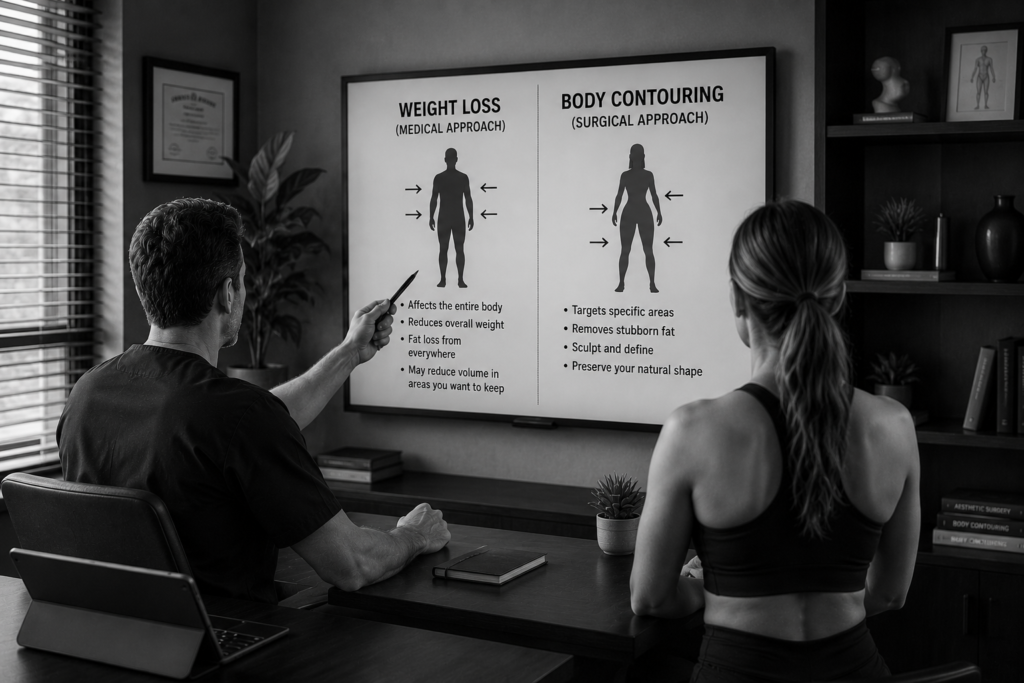
The Two Patients I See Every Week
Every week, two types of patients walk into my clinic having made the same fundamental mistake — just in opposite directions.
The first has been struggling with their weight for years. They’ve heard that liposuction removes fat and they want a lot of it gone. They arrive expecting me to suction away fifteen kilograms and send them home looking like a different person. When I explain that liposuction is not a weight loss procedure, they look at me like I’ve just cancelled Christmas.
The second patient has a perfectly healthy body weight but has always disliked the way their lower tummy sits. They started taking Mounjaro six months ago on someone’s recommendation. They’ve lost weight — including from their face, their chest, and their buttocks. Their tummy looks roughly the same. They come to me confused, lighter, and with noticeably less volume in places they rather liked.
Both patients used the wrong tool. Both wasted time and money. Both are now sitting in my consultation room looking for an explanation.
This is that explanation.
What Body Contouring Actually Is (And What It Is Not)
Body contouring is the surgical reshaping of specific areas of the body. The operative word is specific. Procedures like liposuction, VASER liposuction, J-Plasma liposuction, and tummy tuck (abdominoplasty) are precision instruments. They target defined anatomical regions — a stubborn lower abdomen, flanks that no amount of oblique exercises will shift, an inner thigh that has never once responded to a lunge.
What they are not is a generalised reduction in body mass.
Liposuction removes fat cells from a specific area. It does not trigger the body’s metabolic systems. It does not alter your hormones, your appetite, or your body’s energy regulation. It removes fat from exactly where you point at it, and nowhere else.
This is a feature, not a flaw.
For a patient at a healthy weight who carries stubborn localised fat, this precision is exactly what is needed. For a patient who needs to lose 20 kilograms, this precision is irrelevant. They need a fundamentally different approach.
What Weight Loss Drugs Are Actually Doing to Your Body
Ozempic (semaglutide), Mounjaro (tirzepatide), and newer agents like retatrutide belong to a class of medications that work on the body’s appetite and metabolic signalling pathways. They reduce hunger, slow gastric emptying, and in doing so produce a sustained caloric deficit. The result is generalised weight loss — the body sheds fat across all areas, according to its own internal priorities.
And here is where the problem begins.
- Your body does not consult your aesthetic preferences when deciding where to lose fat first. It follows its own internal logic — one that is entirely indifferent to the fact that you wanted to keep your curves. Women taking these medications frequently lose significant volume from the breasts and buttocks — areas they had no desire to change — while seeing comparatively modest reduction in the lower abdomen, which was the only area they actually cared about.
- Then there is the phenomenon now widely known as Ozempic face: the gaunt, hollow, prematurely aged appearance that results from rapid facial fat loss. This is not a complication in the traditional sense. It is the drug doing exactly what it was designed to do. The face, it turns out, does not get a vote.
- For patients who genuinely need to lose significant body weight for health reasons, these medications can be genuinely transformative. The problem arises when they are used as a substitute for something far more targeted — and something that would have worked considerably better for what the patient actually wanted.
The Wrong Tool for the Wrong Problem
Let us be direct about this.
If your primary concern is meaningful body weight reduction for health reasons — improving metabolic markers, reducing cardiovascular risk, or achieving a clinically significant change in your BMI — weight management through medical, lifestyle, or pharmaceutical means is the appropriate starting point. Ozempic, Mounjaro, and retatrutide belong in this conversation. So does a conversation with your GP or endocrinologist.
If you are at or near a healthy body weight, your health metrics are unremarkable, and you have specific areas of stubborn fat that have not responded to diet and exercise — you need body contouring. You do not need a GLP-1 injection.
These are different problems. They require different solutions. Applying the wrong solution does not produce a half-result. In many cases, it produces no meaningful result in the target area at all, while producing unwanted results elsewhere.
Using Ozempic to reshape your tummy while preserving your waist is, clinically speaking, about as effective as attempting to trim a bonsai tree with a lawnmower. Theoretically related. Practically catastrophic.
The Surgical Options: What Each Procedure Actually Does
For patients who are appropriate candidates for body contouring, several options exist — each with distinct indications, advantages, and practical considerations. Understanding the differences matters.
Liposuction
- The foundational body contouring procedure. Tumescent liposuction involves infiltrating fluid into the target area to facilitate fat removal through a cannula. It is highly effective for isolated fat deposits, has decades of clinical evidence behind it, and remains the most widely performed body contouring procedure in the world.
- It requires anaesthesia, carries standard surgical risks, and involves a recovery period during which compression garments are worn and physical activity is restricted. Results are permanent in the sense that removed fat cells do not regenerate. However, remaining fat cells can expand if significant weight is gained post-operatively. Liposuction is not a licence to abandon the gym.
- Ideal candidate: A patient at or near their goal weight with well-defined areas of localised fat that have not responded to diet and exercise, with good skin elasticity.
VASER Liposuction
- VASER (Vibration Amplification of Sound Energy at Resonance) uses ultrasound energy to selectively liquefy fat cells before removal, allowing for more precise extraction with less trauma to surrounding tissue. It is particularly valuable in areas requiring high-definition results — the abdomen, flanks, and arms — and in patients with fibrous fat, such as those who exercise regularly or have had prior liposuction.
- The ultrasound energy also stimulates some degree of skin contraction, offering a modest tightening effect in addition to fat removal. Recovery is broadly comparable to standard liposuction, with the added benefit of that skin response.
- Ideal candidate: A patient seeking more sculpted, defined results, or one with denser or fibrous fat that standard liposuction would address less efficiently.
J-Plasma Liposuction
- J-Plasma combines liposuction with helium plasma energy delivered through a specialised handpiece beneath the skin. The primary clinical advantage is significant skin contraction — making it especially valuable for patients with mild to moderate skin laxity who want both fat removal and meaningful skin tightening without a formal excisional procedure.
- The tightening effect is considerably more pronounced than VASER alone, and results continue to improve over several months as the tissue contracts and remodels. For patients who would otherwise be borderline candidates for a tummy tuck but prefer a less invasive approach with a less visible scar burden, J-Plasma can represent an appropriate middle ground.
- Ideal candidate: A patient with good fat volume to remove alongside mild to moderate skin laxity, who wishes to avoid or defer excisional surgery.
Tummy Tuck (Abdominoplasty)
- This is a categorically different procedure. A tummy tuck does not simply remove fat — it addresses skin excess, tightens the underlying abdominal wall musculature (including repair of diastasis recti), and repositions the umbilicus. It is the appropriate procedure for patients with loose skin following significant weight loss, post-pregnancy abdominal changes, or muscle separation that no amount of core exercise will correct.
- Liposuction is frequently combined with abdominoplasty for patients who need both fat removal and skin tightening — a common combination following major weight loss. The tummy tuck carries a longer recovery, a more significant scar (though well-concealed within the bikini line), and a correspondingly more significant result.
- It is not a procedure to approach lightly. For the right patient, it is the only procedure that will actually work.
- Ideal candidate: A patient with skin laxity, muscle separation, or excess skin that fat removal alone cannot address — typically following pregnancy or substantial weight loss.
A Simple Framework: Which Path Is Yours?
The question is not which option is better. The question is which option matches your actual situation. The following is a simplified guide — not a substitute for a proper consultation, but a useful starting point.
- You need meaningful weight loss for health reasons, and you’re comfortable with generalised fat reduction across your whole body: Weight management — medical, lifestyle, or pharmaceutical — is your starting point. Ozempic, Mounjaro, and retatrutide are relevant here. Body contouring can be revisited once your weight has stabilised.
- You are at or near a healthy weight with specific areas of stubborn fat that haven’t responded to diet and exercise: You are likely a candidate for liposuction in one of its forms. Book a surgical consultation.
- You have loose or excess skin following weight loss or pregnancy, with or without underlying muscle changes: A tummy tuck — possibly combined with liposuction — is the conversation you should be having.
- You are considering weight loss injections specifically to reshape certain areas while preserving volume elsewhere: Stop. These medications do not work with that level of precision. You will lose volume everywhere your body decides to lose it, in the order it decides. If precision is what you need, a surgical tool is what you need.
The Honest Clinical Reality
Weight loss medications are genuinely useful. They have changed the management of obesity and metabolic disease in ways that are clinically significant. They are not the enemy, and I have no interest in positioning surgical procedures against them as though this were a competition.
But they are being marketed — and used — well beyond their appropriate indication. When a patient at a healthy BMI starts Mounjaro because they want a flatter tummy, they are using a pharmacological sledgehammer to hang a picture frame. The frame goes up. So does half the wall.
Body contouring, equally, is not a shortcut or a magic wand. It requires the right patient, realistic expectations, and a surgeon with equal command of anatomy and aesthetics. A patient who is significantly overweight and seeking liposuction as a primary weight loss strategy is not a good surgical candidate. Any surgeon who tells them otherwise is not doing them a service.
The answer that actually serves the patient is always the same: match the tool to the problem. Every time.
Frequently Asked Questions
Can I have liposuction if I still need to lose weight first?
Yes — and in most cases you should reach your goal weight before proceeding. Patients who are significantly above a stable, healthy weight are generally advised to achieve that stability before body contouring surgery. This produces better results, reduces surgical risk, and ensures the procedure is addressing genuine residual fat deposits rather than overall excess. Liposuction after weight stabilisation, not instead of it.
Will the fat come back after liposuction?
The specific fat cells that are removed do not regenerate. However, if significant weight is gained post-operatively, remaining fat cells in both treated and untreated areas can expand. Most patients find the procedure itself a useful motivational anchor, but long-term results are best maintained with a stable weight.
Do weight loss injections cause permanent fat loss?
No. The fat reduction produced by Ozempic, Mounjaro, and retatrutide is maintained only for as long as the medication is continued and the associated caloric deficit is sustained. Weight regain following cessation is well-documented and can be significant. Liposuction, by contrast, permanently removes fat cells from the treated area.
What is Ozempic face and can it be corrected?
Ozempic face refers to the hollowed, gaunt facial appearance associated with rapid or significant fat loss on GLP-1 and dual GIP/GLP-1 receptor agonist medications. It affects the cheeks, temples, and periorbital areas, producing an appearance that can look prematurely aged. It can be partially addressed with dermal fillers or fat transfer once weight has stabilised, but the most effective management is avoiding it in the first place — which means using these medications only in patients for whom the overall weight loss is clinically justified.
How do I know which procedure is right for me?
A proper consultation with a board-certified plastic surgeon. Not a social media algorithm, not a friend’s experience, and not a comparison of before-and-after photographs. A clinical assessment — of your body composition, skin quality, anatomical priorities, and realistic goals — is the only basis on which the right answer for you specifically can be determined.