
Cellulite Treatment in 2026: Why One Procedure Does Not Fit Every Patient
The diagnosis matters more than the device
Almost every week, I see a patient who has already been through the full circuit — creams, massage, lymphatic drainage, energy-based machines, sometimes an injectable or two — and is sitting in front of me saying some version of the same thing:
“My skin feels a little smoother, but the dimples are exactly where they were.”
That sentence captures the cellulite problem precisely. And it tells me, before I’ve even looked at the patient, that the treatment didn’t match the diagnosis. Not that the treatment was useless — but that it was probably used for the wrong type of cellulite.
Cellulite is not a single condition. It is a clinical presentation with several different underlying causes, and the treatment that works well for one patient may do very little for another — not because the procedure is ineffective, but because the mechanism doesn’t match the problem.
That is what this article is about. Not which device is newest. Not which injectable is trending. But how we actually diagnose cellulite correctly in 2026, and why that diagnosis should drive every treatment decision that follows.
What Cellulite Actually Is — And Why It Resists Simple Solutions
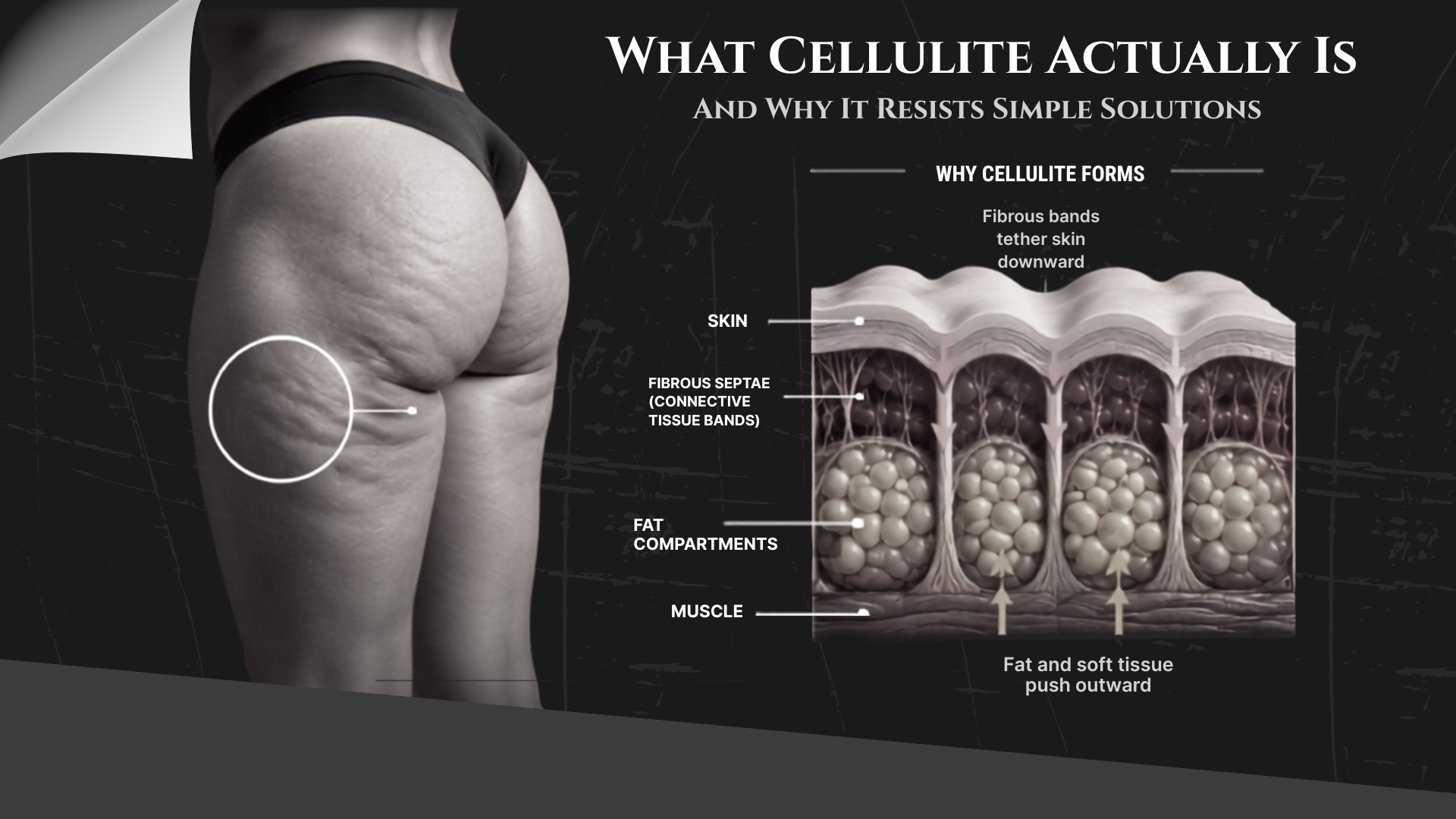
Cellulite describes the dimpled, uneven, orange-peel or mattress-like appearance of the skin, most commonly on the thighs, buttocks, hips, and abdomen. It is extraordinarily common — reviews estimate it affects around 80–90% of post-pubertal women — and it is not a marker of weight, fitness level, or lifestyle. Slim, athletic women develop cellulite. It is predominantly an anatomical problem.
Under the skin, fat is arranged in compartments separated by fibrous connective tissue bands — called septae. In women, the orientation of these septae and fat compartments differs structurally from men, which creates a predisposition to dimpling. In cellulite, specific fibrous bands tether the skin downward while the surrounding fat and soft tissue push outward. That mechanical tension between anchored skin and outward-pushing tissue is what creates the visible pit or dimple.
This is why cellulite is so resistant to simple solutions. You can reduce the fat. You can improve muscle tone. You can hydrate the skin. But if the fibrous band is still pulling the skin downward, the dimple remains. The cause is structural — and structural problems require structural solutions.
Why Cellulite Is a More Complex Problem Than Most Patients Realise
Cellulite frustrates patients — and, frankly, many practitioners — because it is almost never a single isolated problem. The underlying contributors in any given patient may include:
- Fibrous septae tethering the skin downward
- Fat lobules pushing upward against the skin
- Reduced skin quality or dermal thinning
- Skin laxity or loss of elasticity
- Fluid retention or swelling tendency
- Hormonal and genetic predisposition
- Lipedema or disproportionate lower-body fat distribution
- Contour irregularities from previous procedures
This combination of contributing factors is why one patient may respond well to a targeted subcision procedure, while another requires subcision combined with collagen stimulation, and a third may actually need liposuction, skin tightening, or surgical lifting before any surface-level cellulite treatment becomes worthwhile.
This is also why many patients have been disappointed by treatments that are perfectly legitimate tools — but were applied to a problem they were never designed to solve.
Why Topical Treatments Usually Fail for Deep Cellulite
It is worth being precise here, because creams and topical treatments are not entirely without effect. Ingredients such as caffeine can temporarily reduce the appearance of superficial puffiness by dehydrating superficial tissue. Retinol used consistently over time may modestly improve dermal thickness. Moisturising agents and peptides improve the surface feel and texture of the skin.
But deep cellulite dimples are not caused by dry or under-moisturised skin. They are caused by structural tethering from beneath — and a topical agent cannot reach, let alone release, a fibrous band sitting several millimetres below the skin surface. Topical treatments may polish the surface. They cannot address the underlying architecture.
That is the honest limitation, and patients deserve to hear it plainly rather than discovering it after several months and several hundred dirhams’ worth of creams.
The Evolution of Cellulite Treatment: What Came Before, and What We Learned
Modern cellulite treatment didn’t arrive out of nowhere. Each generation of technology built on the lessons — and the limitations — of the one before it.
Massage, Suction, and Lymphatic Therapies
These include vacuum therapy, endermologie-style treatments, manual lymphatic drainage, and various forms of mechanical stimulation. They can improve circulation, reduce short-term puffiness, and temporarily improve tissue softness. For patients with swelling or sluggish lymphatic flow, they have a legitimate role in management.
What they do not reliably do is release a specific tethering band or permanently restructure fibrous septae. Their benefit is real but predominantly temporary, and they are better thought of as supportive care than as primary cellulite treatment.
Cellulaze
Cellulaze was among the earlier minimally invasive laser approaches to cellulite. It used a 1440-nm Nd:YAG laser to target fibrous septae, superficial fat, and the underside of the dermis. Clinical studies reported meaningful improvement. More importantly, Cellulaze helped move the clinical conversation in the right direction: cellulite is not a surface problem, and treating only the surface produces predictably incomplete results.
Manual Subcision and CelluErase
Manual subcision techniques, including CelluErase, operate on the same fundamental principle that still underpins the best cellulite treatments today: release the fibrous bands that are physically tethering the skin downward. When the problem is a focal, clearly tethered pit and the technique is accurate, subcision can produce a genuinely meaningful improvement. Its limitations relate to consistency — the outcome depends heavily on the surgeon’s ability to identify the responsible band precisely and release it at the correct depth.
Cellfina
Cellfina represented a significant step toward standardising subcision. By using tissue stabilisation and a controlled-depth cutting mechanism, it made the procedure more reproducible. Long-term follow-up data supported durability of improvement. The principle, however, remained unchanged: identify and release the tethering band. The device improved the execution; the concept predated it.
QWO (Now Discontinued)
QWO was an injectable collagenase treatment that approached band release through enzymatic rather than mechanical disruption — a chemically different method for the same structural goal. It was discontinued by the manufacturer in 2022, largely due to concerns regarding significant bruising and skin discolouration in a substantial proportion of treated patients. The concept was sound. The side-effect profile undermined its clinical use.
Current Generation: Targeted Subcision Devices
The current generation of targeted subcision devices — of which Avéli is one example — aims to improve the precision and verifiability of band release. The clinical rationale is consistent with everything that preceded it: identify the specific septal band responsible for the dimple, release it, and confirm that the release is complete. Published data on these devices supports improvement in well-selected patients at follow-up through twelve months.
What is worth stating clearly: targeted subcision, regardless of the device used, is not a treatment for every form of cellulite. It is a treatment for tethered dimples caused by fibrous bands. For patients whose primary problem is diffuse texture, skin laxity, lipedema, or loose skin after weight loss, subcision alone addresses only one component of a more complex picture.
Classifying Cellulite Correctly: The Only Starting Point That Makes Sense
Before any treatment recommendation can be made sensibly, cellulite must be assessed and categorised. The categories below are not academic — they are clinically practical, and they directly determine the treatment approach.
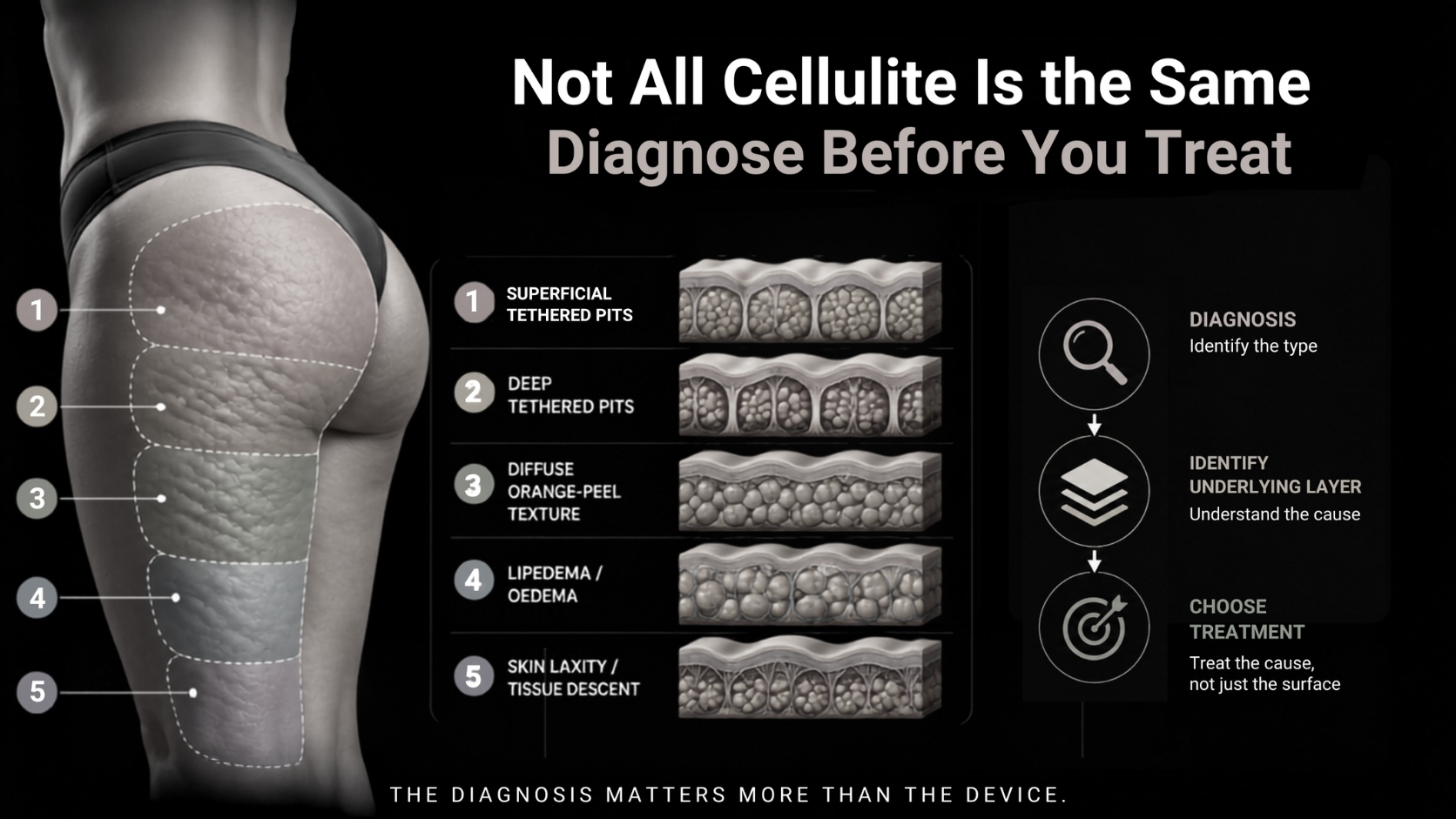
1. Superficial Tethered Pits
These are visible dimples of moderate depth, often more apparent when standing or when the skin is gently compressed. The surrounding skin quality is reasonably preserved. The dominant problem is a specific fibrous band anchoring a small area of skin downward.
Treatment direction
Targeted subcision. When the pit is clearly tethered and skin elasticity is adequate, releasing the band can produce a satisfying and durable improvement.
2. Deep Tethered Pits
These are more aggressive depressions — the skin is pulled down more substantially, the pit is visible even at rest, and there may be some compromise in the overlying skin quality. The fibrous band here tends to be stronger or deeper, and the skin may have lost some of its structural resilience.
Releasing the band is still necessary, but band release alone may not fully resolve the problem when the dermis is thin or the surrounding tissue has poor structural support.
Treatment direction
Subcision combined with collagen stimulation. Biostimulators such as poly-L-lactic acid (Sculptra, Lanluma) or hyperdiluted calcium hydroxylapatite (Radiesse) can improve dermal thickness and structural support after band release. The two goals are sequential: first address the tether, then improve the quality and resilience of the overlying skin.
Treating the band without addressing poor skin quality often produces an incomplete result.
3. Diffuse Texture — Orange-Peel or Mattress-Like Cellulite
This is the most common presentation and arguably the most underestimated in its complexity. Rather than discrete dimples, the affected area has widespread surface irregularity — multiple small tethering points, variable skin support, early laxity, and superficial fat irregularity spread over a large zone.
Targeting individual bands in this scenario addresses only part of the problem. The diffuse nature of the irregularity means that the tissue architecture needs to be improved more broadly, not just released at isolated points.
Treatment direction
Combination and staged treatment. Selective subcision for the most prominent pits, combined with collagen stimulation, skin-tightening technologies, and a staged treatment schedule. Expecting a single procedure to correct diffuse cellulite is unrealistic. The plan needs to match the scope of the problem.
4. Cellulite Associated with Oedema, Heaviness, or Lipedema
This category requires particular attention because it is frequently misidentified — by patients and by practitioners.
Lipedema is a chronic fat-distribution disorder that predominantly affects the lower body. It is characterised by disproportionate lower-body volume, tissue tenderness, easy bruising, a feeling of heaviness, and a pattern of fat accumulation that does not respond to diet or exercise in the way ordinary adiposity does. Recent literature emphasises that lipedema is significantly underdiagnosed and is commonly mislabelled as obesity, cellulite, or lymphoedema.
In patients with lipedema or significant lower-body oedema, treating surface-level dimples first produces an understandably disappointing result — because the dominant problem is not at the surface.
Treatment direction
Address the deeper pathology first. For appropriate candidates, this may include lymphatic assessment, compression therapy, conservative management, and in selected patients, specialised liposuction for lipedema-type tissue. Once the volume, heaviness, and tissue quality have been improved at the structural level, any remaining focal cellulite pits can be reassessed and treated as a second stage.
5. Cellulite Associated with Skin Laxity or Tissue Descent
This is one of the most frequently misclassified presentations — and the mismatch between diagnosis and treatment here produces some of the most predictably disappointing outcomes I see in revision consultations.
Many patients present describing “cellulite,” when what they are actually dealing with is tissue deflation, buttock descent, or posterior thigh laxity. This presentation has become considerably more common in the era of GLP-1 medications such as semaglutide and tirzepatide — drugs that can produce substantial and relatively rapid weight loss. As fat volume decreases, the skin and soft tissue envelope that surrounded it may no longer have adequate tension. The buttock descends, the posterior thigh sags, and the cellulite appears worse not because new dimples have formed, but because the skin is no longer under adequate structural tension.
In these patients, subcision addresses one variable in an equation that has several others. The primary problem is not a tethering band — it is a loose, descended skin envelope.
Treatment direction
Surgical lifting when the degree of laxity warrants it. A buttock lift or lower body lift removes the excess skin, re-establishes appropriate tissue tension, and addresses the descent that is driving the worsened appearance. Any focal cellulite dimples that remain after the structural correction can be managed separately, with considerably better tissue conditions to work with.
The Role of Liposuction in Cellulite — And Its Clear Limitations
Liposuction removes fat. Cellulite is not fundamentally a fat problem. This distinction matters.
If the primary cause of visible dimpling is a fibrous band tethering the skin, liposuction does not address that band. In patients where aggressive liposuction is performed without attention to skin quality and structural support, the surface irregularity can in fact be made worse — not because the liposuction was poorly executed, but because removing fat from beneath already-compromised skin can reduce the support that was partially masking the structural problem.
That said, liposuction has a clear and appropriate role in cellulite management when the underlying issue involves:
- Lipedema-type fat distribution
- Heavy or disproportionate lower-body volume
- Localised fat deposits affecting contour
- Lower-body disproportion reducing the patient's overall aesthetic response to other treatments
In these situations, VASER liposuction can meaningfully improve the volume, contour, and tissue environment — after which any remaining focal cellulite can be addressed in a second stage with considerably better underlying conditions.
The principle is straightforward: address the structural architecture first. Then treat what remains at the surface.
The Role of Skin Tightening — And When It Is Not Enough
Energy-based skin-tightening technologies improve dermal collagen, reduce laxity, and enhance tissue firmness. For mild-to-moderate skin laxity with superficial texture irregularity, they have a genuine role in the overall treatment plan.
However, if a specific fibrous band is pulling the skin into a pit, tightening the tissue around that band does not release the tether. The skin may become firmer overall, but the dimple may persist because the structural cause has not been addressed.
The clinical framework is not complicated:
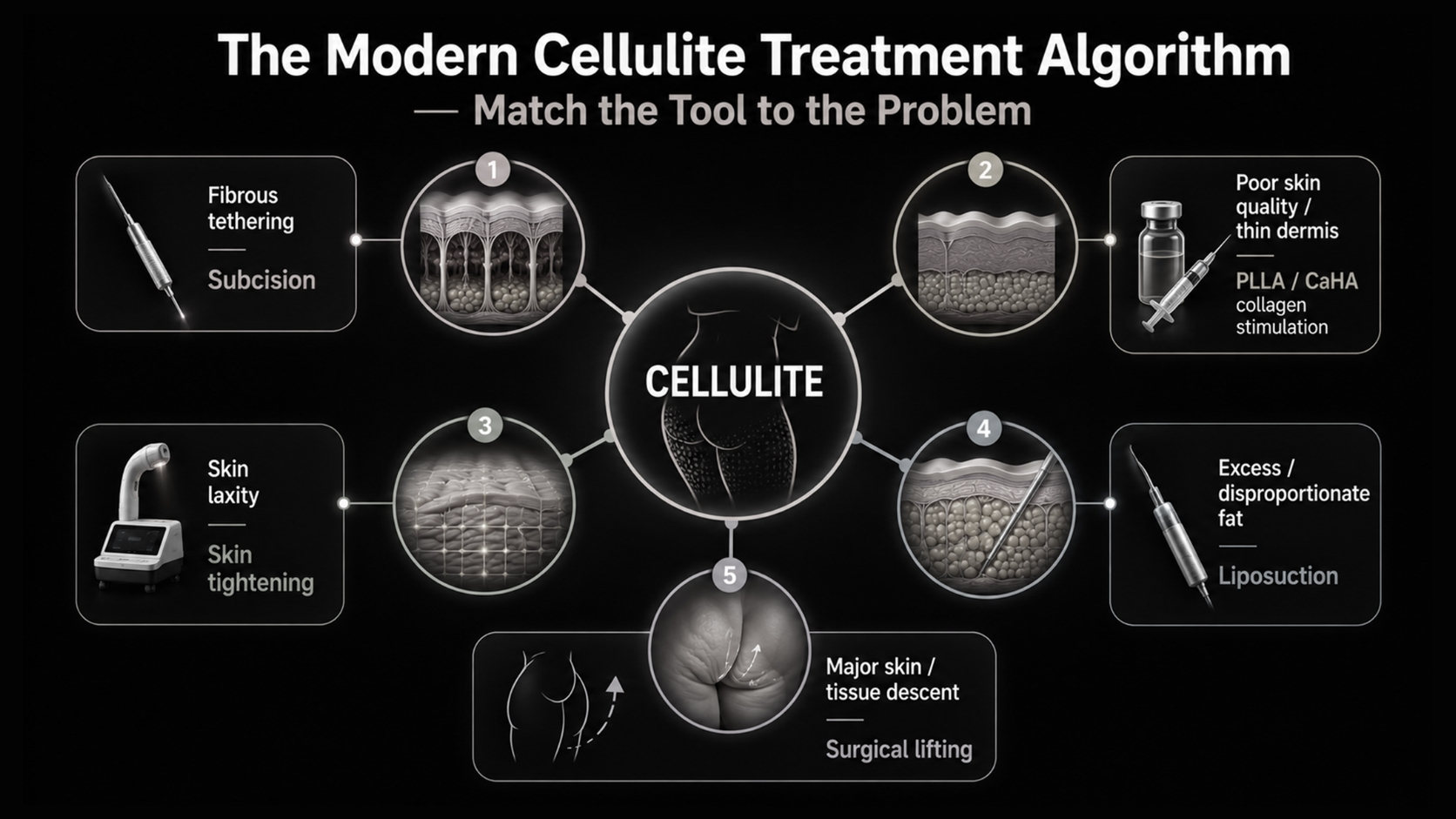
Goal | Tool |
Release a tethering band | Subcision |
Improve skin quality and structural support | Biostimulators (PLLA, CaHA) |
Improve tissue firmness and laxity | Skin-tightening technologies |
Improve volume, contour, or lipedema | Liposuction |
Correct tissue descent and excess skin | Surgical lifting |
Modern cellulite treatment is not about selecting the most sophisticated device. It is about selecting the correct tool for the correct layer of the problem.
Can Cellulite Be Permanently Removed?
This is the question that deserves an honest answer rather than a reassuring one.
The accurate term is reduction, not removal. Cellulite is influenced by anatomy, genetics, hormonal environment, skin quality, weight fluctuation, and ageing — most of which are ongoing biological processes rather than static conditions. Treatment can produce meaningful, durable improvement. It does not produce immunity to further change.
The patients who achieve the most satisfying results are those in whom:
- The cellulite type has been correctly identified before treatment begins
- The treatment matches the specific mechanism driving the problem
- Skin quality and laxity have been properly accounted for
- Lipedema or significant oedema has been recognised and addressed appropriately
- Weight is stable at the time of treatment
- Expectations are calibrated to improvement rather than perfection
- Treatment is staged where the problem requires it
Realistic expectations, set from the beginning of the consultation, are not a disclaimer — they are part of the clinical plan.
The Bottom Line
Cellulite treatment has advanced considerably over the past two decades — from surface treatments and non-specific massage to targeted structural interventions, collagen stimulation, and precise subcision techniques.
What has not changed — and should not — is the foundational principle: if a fibrous band is tethering the skin downward, that band must be released. If the skin is thin and poorly supported, the dermal architecture must be improved. If the tissue is heavy and disproportionate, the volume must be addressed first. If the skin is loose and descended, structural lifting is the correct starting point.
No single device, injectable, or procedure covers all of those scenarios. The treatment that is genuinely right for a patient with one focal dimple and good skin quality is categorically not the same treatment that is right for a patient with lipedema, diffuse thigh irregularity, and significant posterior descent after 30 kg of weight loss.
So before asking which treatment is the best, ask the more useful question:
What type of cellulite is this — and which layer of the problem needs to be treated first?
That is where the correct answer begins. And that is what we work through together in consultation before any recommendation is made.
👉 Book a Consultation | Body Contouring Dubai | VASER Liposuction Dubai | Tummy Tuck | Revision Liposuction
Medical disclaimer: This article provides general educational information and does not replace an in-person medical assessment.
About the Author
Dr. Hardik Ganatra | Body Contouring Specialist | Plastic Surgeon | Dubai, UAE
10+ years experience. Specialties: High Definition Liposuction, Tummy Tuck, Body Contouring for weight loss patients, Brazilian Butt Lift. Philosophy: every transformation should be life-changing, artistic, and natural. Works with patients regionally and globally.
Medical disclaimer: This article provides general educational information and does not replace an in-person medical assessment.