
Expert VASER Lipo 360 in Dubai
Lipo 360 in Dubai: Sculpt and Define Your Entire Torso
Many patients come to me asking for one small area.
"Doctor, I only want the lower tummy." "Can you just remove the love handles?" "My abdomen bothers me, but I don't think I need the back."
Sometimes an isolated area really is all that needs treatment. But very often, when I examine a patient standing and look at the body from the front, side, and back, the problem isn't limited to one pocket of fat. The abdomen, waist, flanks, back, and sometimes the chest or armpit area are all connected.
Treating only the front can leave the sides looking heavy. Treating only the lower tummy can leave the upper abdomen looking full. Flattening the stomach while leaving back folds and love handles behind can make the torso look unfinished.
I wouldn't want to do a half-hearted job. When the anatomy calls for it, I always go for a comprehensive 360 approach — not because it's the bigger operation, but because it's the honest one.
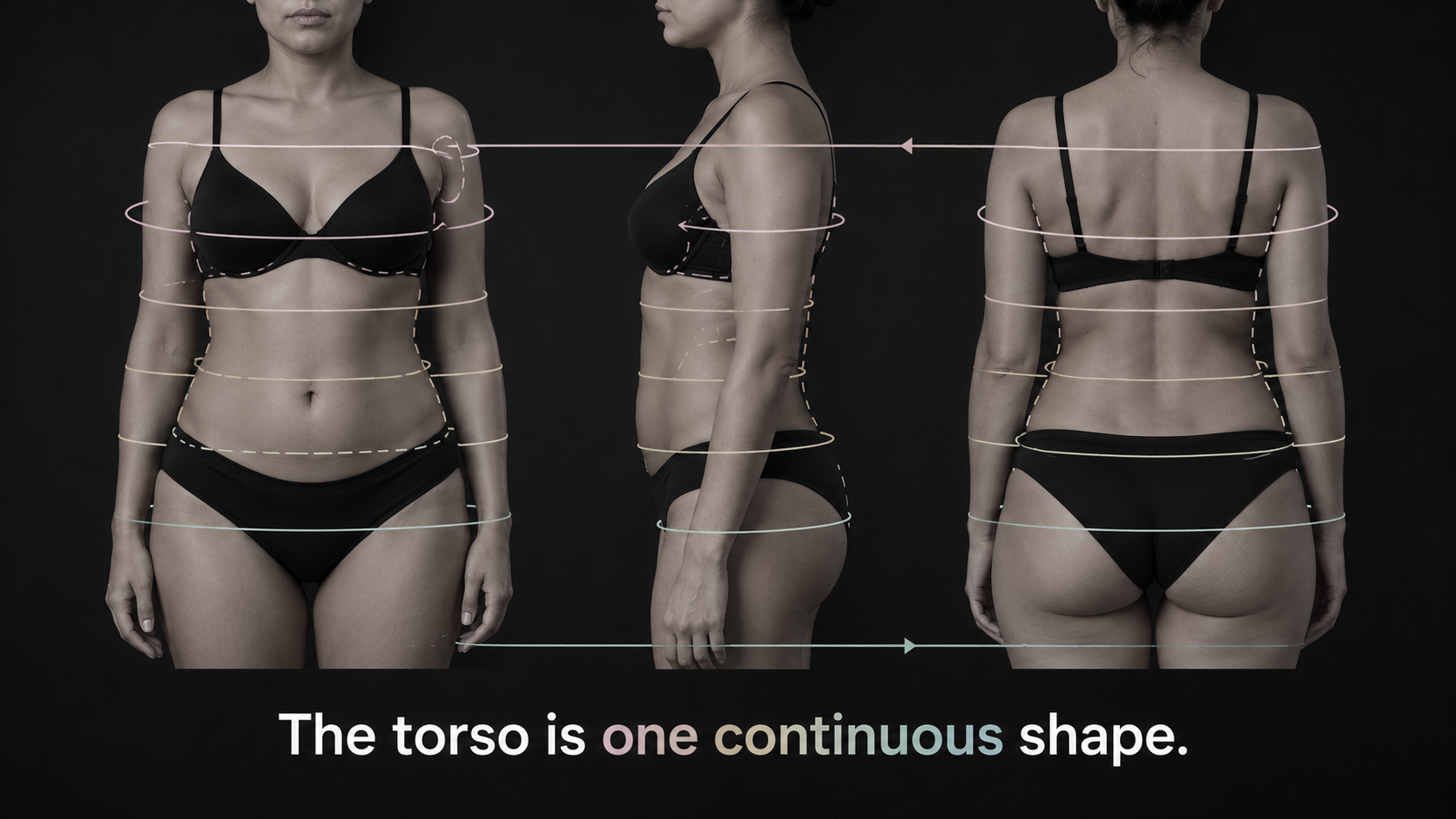
That's where Lipo 360 comes in. It treats the torso as one connected shape, rather than a collection of separate body parts.
What Is Lipo 360?
Lipo 360 is comprehensive liposuction of the torso.
The word "360" means the body is assessed and treated all the way around — front, sides, and back.
It doesn't mean every patient gets exactly the same operation. The areas included depend on whether the patient is male or female, where the fat sits, the quality of the skin, previous surgery, and the shape the patient wants.
In my practice, Lipo 360 isn't simply abdominal liposuction with a bit of extra work on the sides. It's a complete torso-contouring plan.
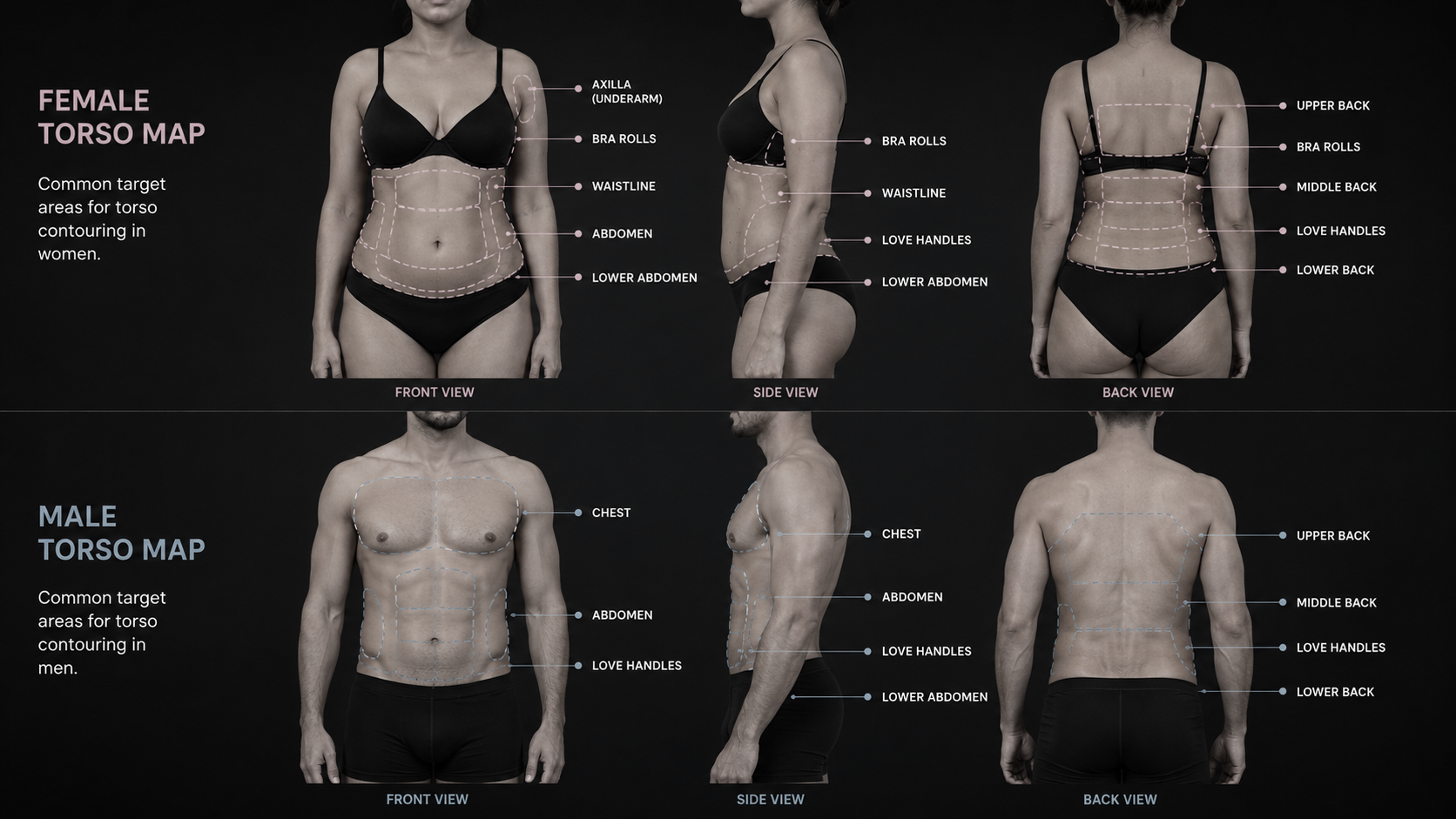
For women, Lipo 360 commonly includes:
- Upper and lower abdomen
- Waistline
- Flanks and love handles
- Axilla or armpit area when needed
- Upper back
- Middle back and bra rolls
- Lower back
For men, Lipo 360 commonly includes:
- Chest
- Axilla or armpit area
- Upper and lower abdomen
- Flanks and love handles
- Upper back
- Middle back
- Lower back
The operation removes stubborn subcutaneous fat and improves proportion. It's important to be precise here, for patients and for colleagues reading this: liposuction addresses subcutaneous fat, not the metabolically active visceral fat around the organs. Research on large-volume subcutaneous liposuction has shown it can produce genuine aesthetic and even modest cardiovascular benefit, but animal studies suggest that only visceral fat removal meaningfully affects insulin resistance — subcutaneous liposuction remains primarily a cosmetic procedure rather than a metabolic one. I explain this clearly at consultation because it shapes expectations honestly. Lipo 360 is not a substitute for weight loss.
Why Choose Lipo 360 Instead of Treating One Area?
The torso doesn't stop at the abdomen.
A flat stomach can still look unbalanced if the waist stays thick, the back has folds, or the love handles keep projecting from the sides.
This is why I look at a patient from every angle before deciding what needs treatment. A patient may be focused only on the lower tummy because that's what she sees when she looks down. But from the side, the waist may be the bigger issue. From the back, the bra rolls or love handles may be hiding the shape completely.
In men, the abdomen may be only one part of the problem. Chest fullness, armpit fat, thick flanks, and lower-back fat can stop the torso from looking athletic, even when the stomach becomes flatter.
Lipo 360 creates smoother transitions between the chest, abdomen, waist, flanks, lower back, and buttock area.
The goal isn't to remove fat from as many areas as possible. The goal is to make the torso look connected — and I'd rather plan for that properly the first time than send a patient home with a job I know is only half done.
Why Do Patients Ask for Only One Area?
They are worried about recovery. Patients often assume that treating more areas automatically means a much longer or harder recovery. A larger procedure does involve more swelling, soreness, garment coverage, and aftercare. But treating connected areas together may still be more practical than having several separate surgeries and several separate recoveries.
They want to reduce the cost. This is understandable. But treating only one part of a connected problem can leave the result feeling incomplete. The patient may later return for the flanks, back, waist, or upper abdomen and go through another operation.
They are focused only on the front view. Most patients look at their abdomen in a mirror. They may not realize how much the waistline, bra rolls, back folds, and lower-back fat contribute to their overall shape until I show them during consultation.
This doesn't mean everyone needs Lipo 360. If the fat is genuinely isolated and the surrounding torso is already balanced, a smaller procedure may be perfectly reasonable. I'd rather tell a patient honestly that they don't need the bigger operation than talk them into one. The decision should come from a full assessment, not simply from the first area a patient points to.
What Happens if I Treat Only the Abdomen?
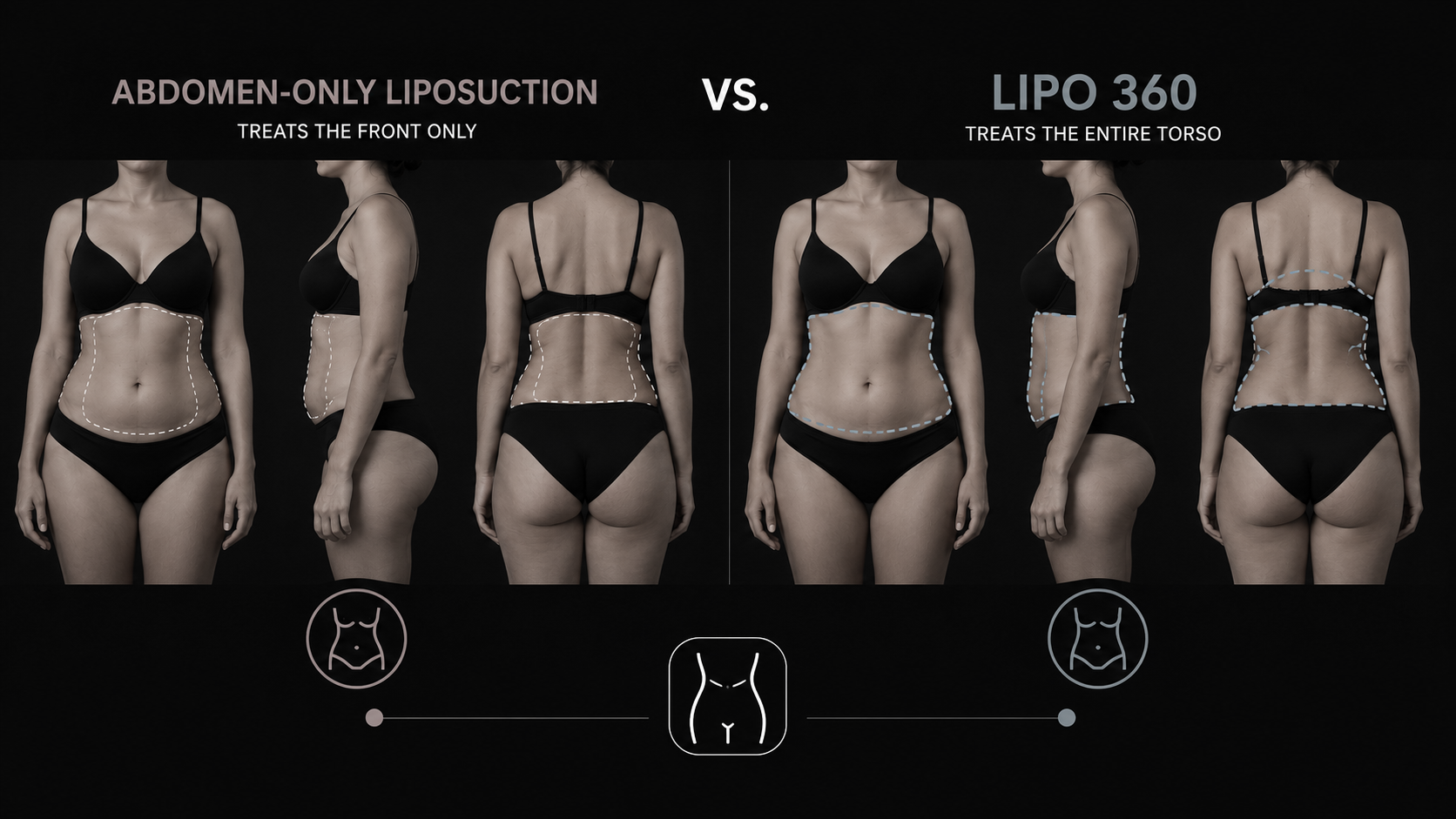
Treating only the abdomen isn't necessarily wrong. It works well when the flanks, waist, and back are already lean and proportionate.
The problem starts when a patient has connected fat deposits but chooses to treat only the front. The abdomen may become flatter while the waist stays wide, the flanks keep projecting, the back folds remain visible, and the lower back stays bulky.
If the patient later gains weight, the remaining fat cells can enlarge. Untreated areas may become more noticeable, because their fat cells were never removed.
"My stomach is flat, but now my back bothers me even more."
I'd rather explain this possibility before surgery than have a patient feel disappointed afterward. This is exactly the half-hearted result I try to avoid — a technically successful procedure that leaves an incomplete picture
Lipo 360 for Women
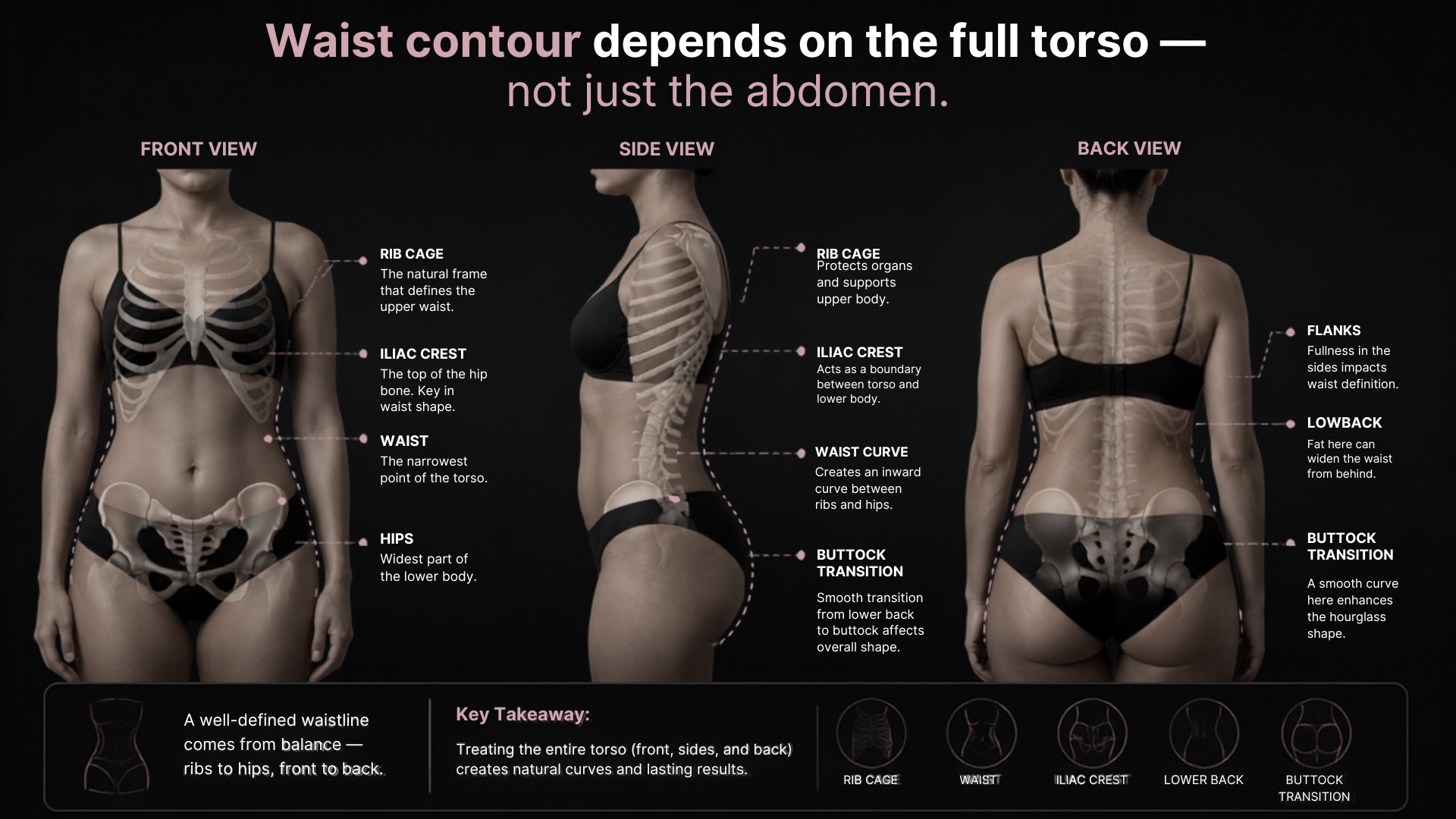
For women, the waistline is one of the most important parts of the operation.
Removing abdominal fat can make a woman look slimmer. Shaping the waistline can make her look curvier.
A female torso shouldn't simply be reduced evenly from top to bottom. The waist needs to be shaped in relation to the ribs, hips, flanks, lower back, and buttocks.
During female Lipo 360, I pay particular attention to:
- Upper abdominal fullness
- Lower abdominal fullness
- Flank projection
- Love handles
- Lower-back thickness
- Waist-to-hip transition
- Bra rolls and middle-back folds
- Upper-back and axillary fullness
Some women want a soft, natural waist. Others want a more dramatic hourglass shape. I plan the result around the patient's own anatomy and personality, not a fixed template. Liposuction can shape the soft tissue, but it can't change the rib cage or pelvis — a limitation I make sure every patient understands before we plan anything.
Lipo 360 for Men
In men, the aim is usually different.
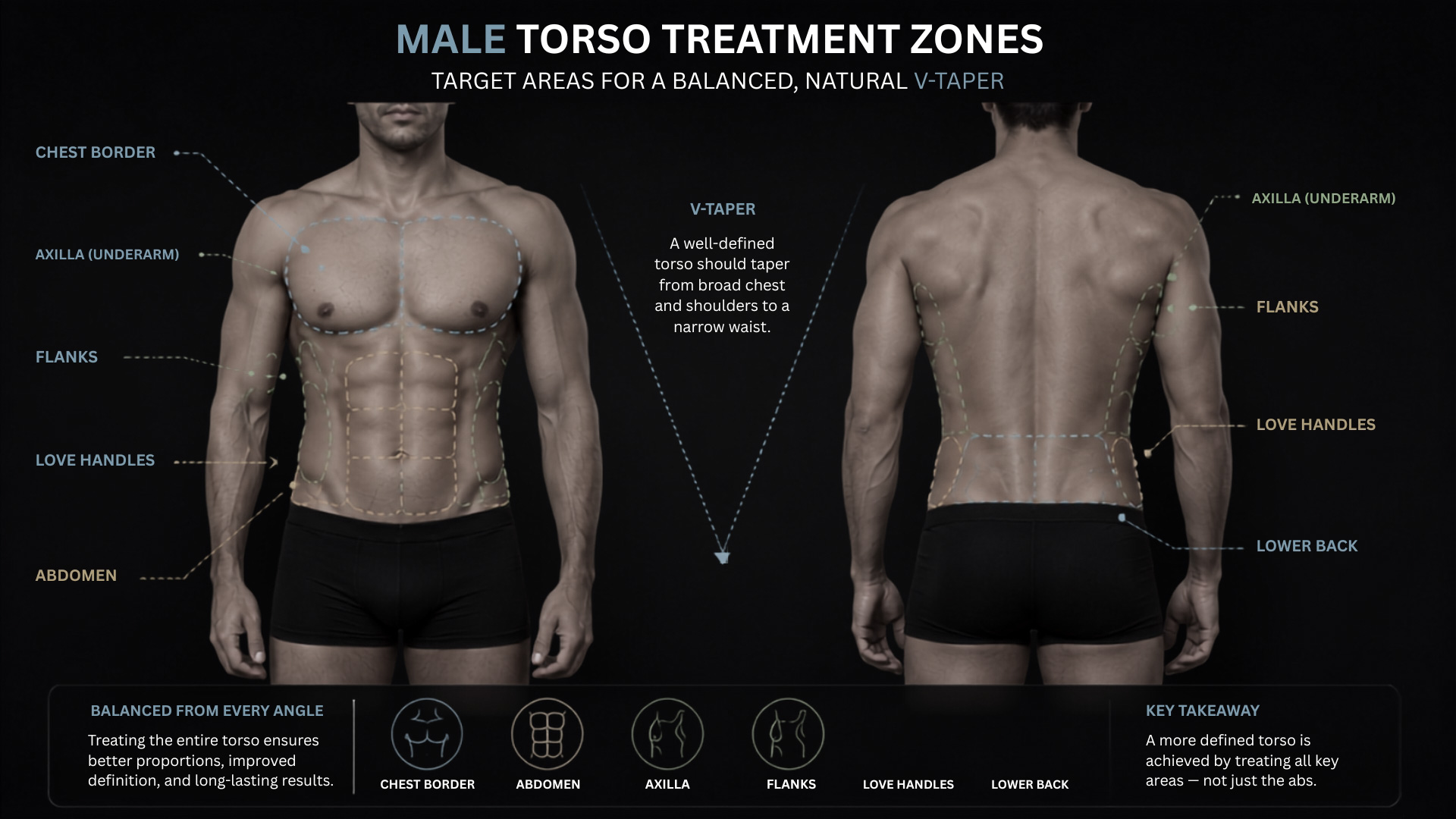
Most men don't want an hourglass shape. They want a flatter abdomen, reduced love handles, a cleaner chest, and a stronger taper from the shoulders toward the waist.
For this reason, a male torso plan may include the chest, armpit area, abdomen, flanks, love handles, and the full back.
The lower back and love handles are often the most frustrating areas for men. A man may train regularly and reduce his abdominal fat but still struggle with a thick waist or lower-back pockets that refuse to move.
Treating the abdomen without the flanks and lower back may flatten the front but fail to create an athletic V-taper.
I always aim for a male Lipo 360 result that makes the torso look leaner and stronger — not simply smaller. That distinction matters more to me than almost anything else in male body contouring.
Upper, Middle, and Lower Back Liposuction
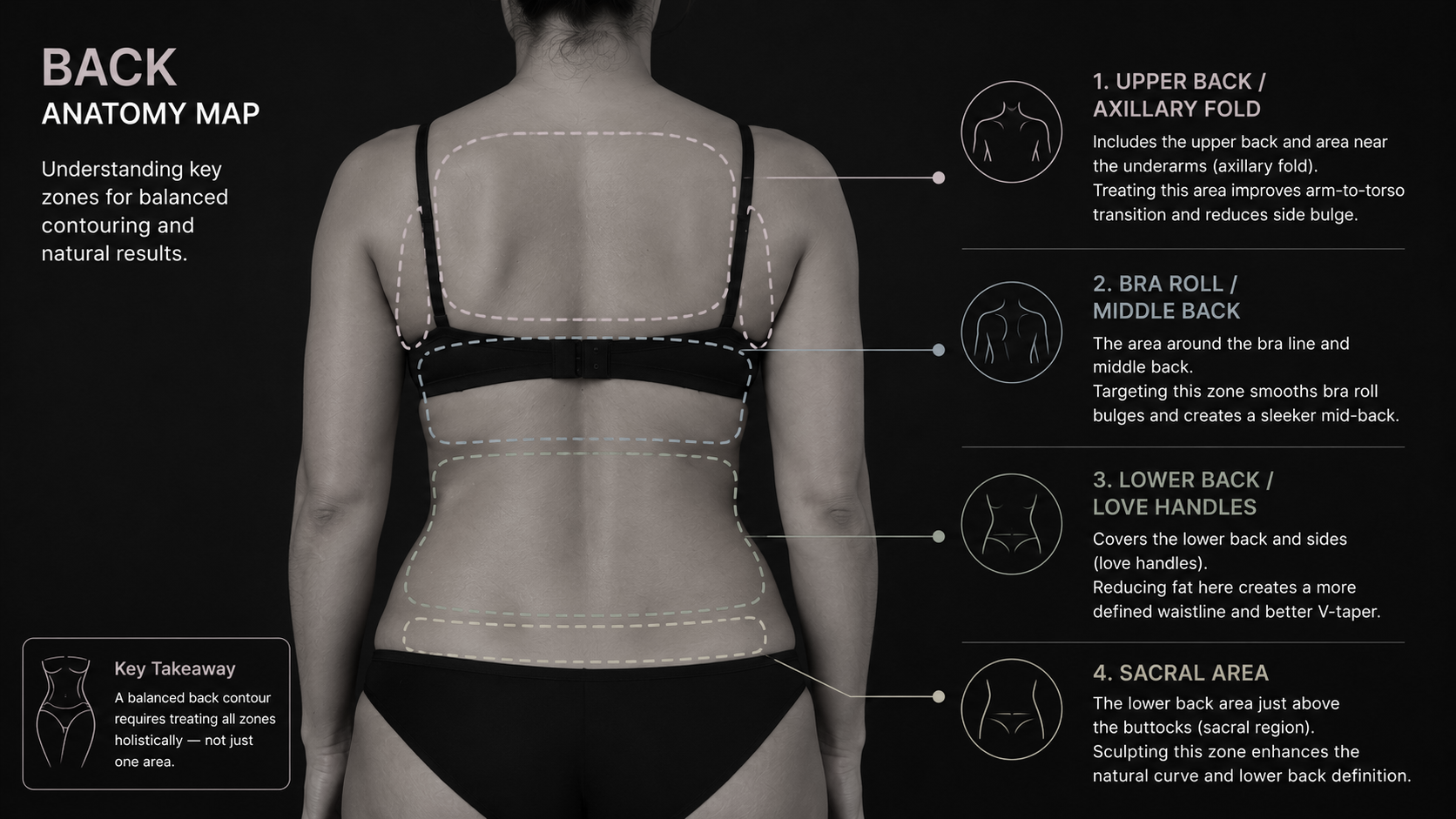
Back liposuction is not one area. The upper, middle, and lower back behave differently and need different planning.
Upper-back and axillary fullness. Some women develop fullness around the upper back and armpit area that makes the shoulders and torso look broader. From behind, this can create a fold along the upper back. Treating it can make the upper body appear lighter and improve the transition between the arms, armpit, and back.
Middle-back and bra-roll fat. The fold under or around the bra strap is commonly called the bra roll or bra fold. Fat can bulge above and below the strap and show through fitted clothing. The bra doesn't necessarily cause the fat, but it makes the fold more obvious by pressing through the area.
Lower-back fat and love handles. Lower-back fat sits above the buttocks and around the flanks. In women, reducing it can improve the waist and waist-to-buttock transition. In men, it's one of the most stubborn areas and often prevents the torso from developing a cleaner V-shape.
Back fat is frequently dense and fibrous, which is exactly why I prefer VASER when treating it — the ultrasound energy handles fibrous tissue more predictably than traditional cannula work alone.
Slim-Down Lipo 360 or High-Definition Lipo 360?
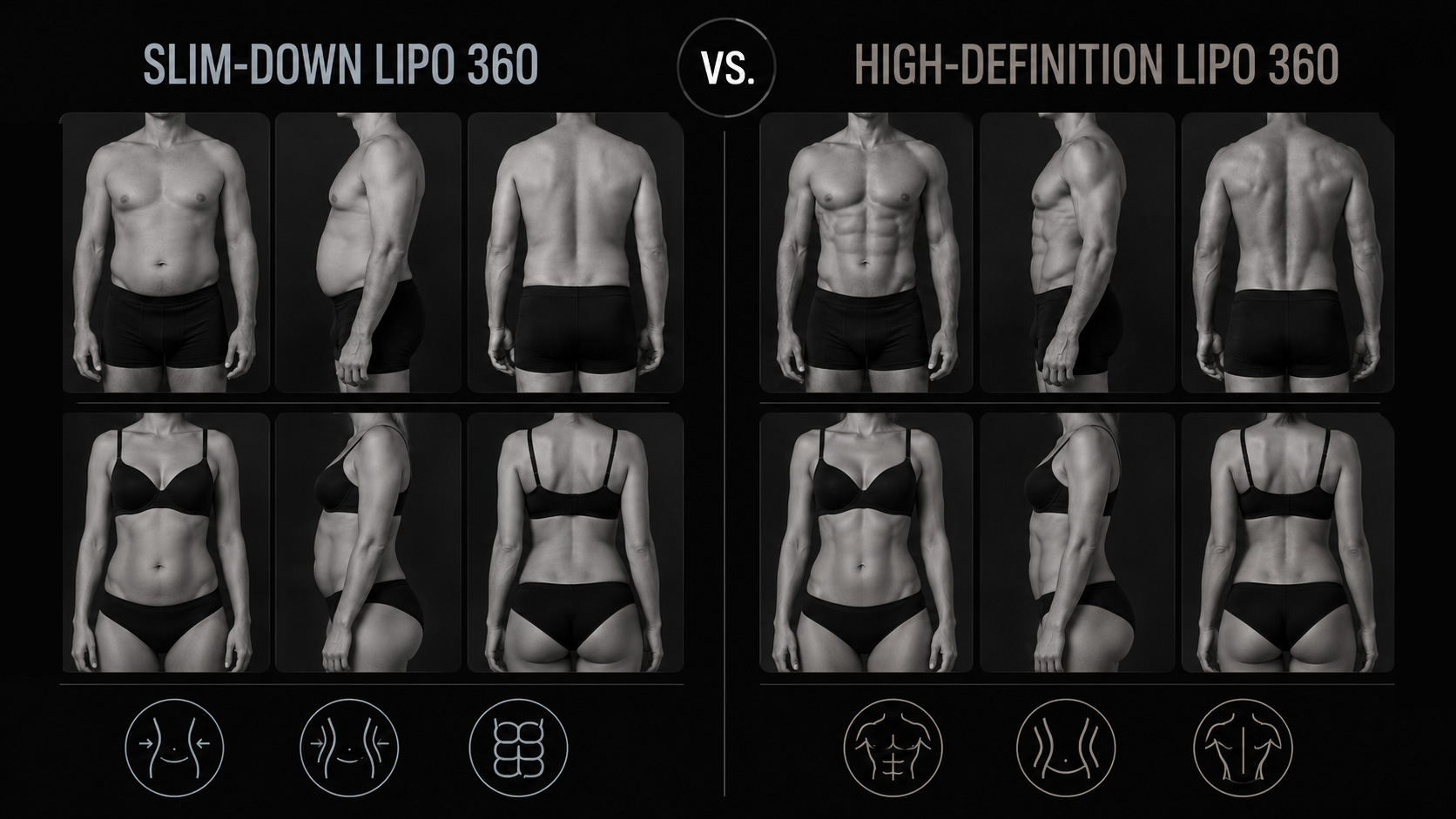
Slim-down Lipo 360. Some patients simply want to look smaller, lighter, smoother, and better proportioned. For these patients, I focus on reducing bulk and creating a smooth torso without strong muscle definition
High-definition Lipo 360. Other patients want a more athletic look. They may want visible abdominal lines, a sharper male chest, better obliques, stronger waist definition, lower-back lines, or more visible muscle structure. High-definition Lipo 360 requires more detailed marking and more selective fat removal.
The first question I ask isn't "Which technique is more advanced?" It's "How do you want your body to look?" I've found that patients — and honestly, junior colleagues learning this work — often reverse that order, and it shows in the result.
What Is VASER Lipo 360?
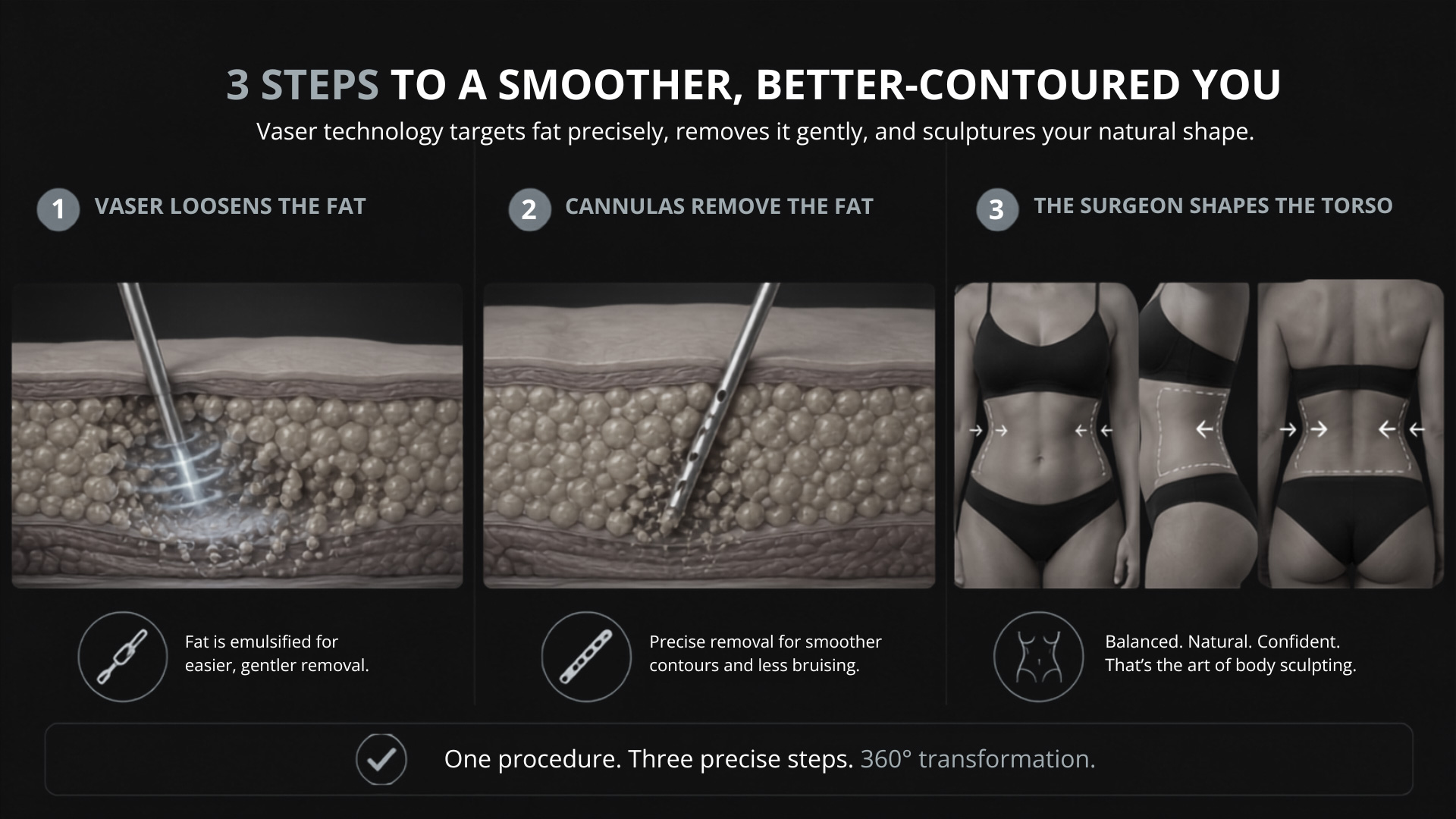
VASER Lipo 360 means VASER ultrasound-assisted liposuction is used while contouring the torso all the way around.
VASER uses ultrasound energy to loosen and emulsify fat before it's removed. This isn't just my personal preference speaking — the published evidence backs it up. Third-generation ultrasound-assisted liposuction has been shown in peer-reviewed series to be effective and safe, with complication rates lower than traditional liposuction and equal or higher patient satisfaction, and separate single-centre series have reported similarly favourable safety and aesthetic outcomes across large patient cohorts.
I prefer adding VASER to most of my Lipo 360 procedures because it's particularly useful in dense abdominal fat, fibrous back fat, male chest fat, love handles, high-definition sculpting, revision liposuction, and previously operated areas.
VASER may make fat extraction smoother, but it doesn't plan the shape. It doesn't decide how narrow the waist should be, where the chest should end, or when enough fat has been removed. That judgment doesn't come from the device.
Technique always beats technology. I say this to patients, and I say it just as often to the surgeons I train.
What Is J-Plasma Lipo 360?
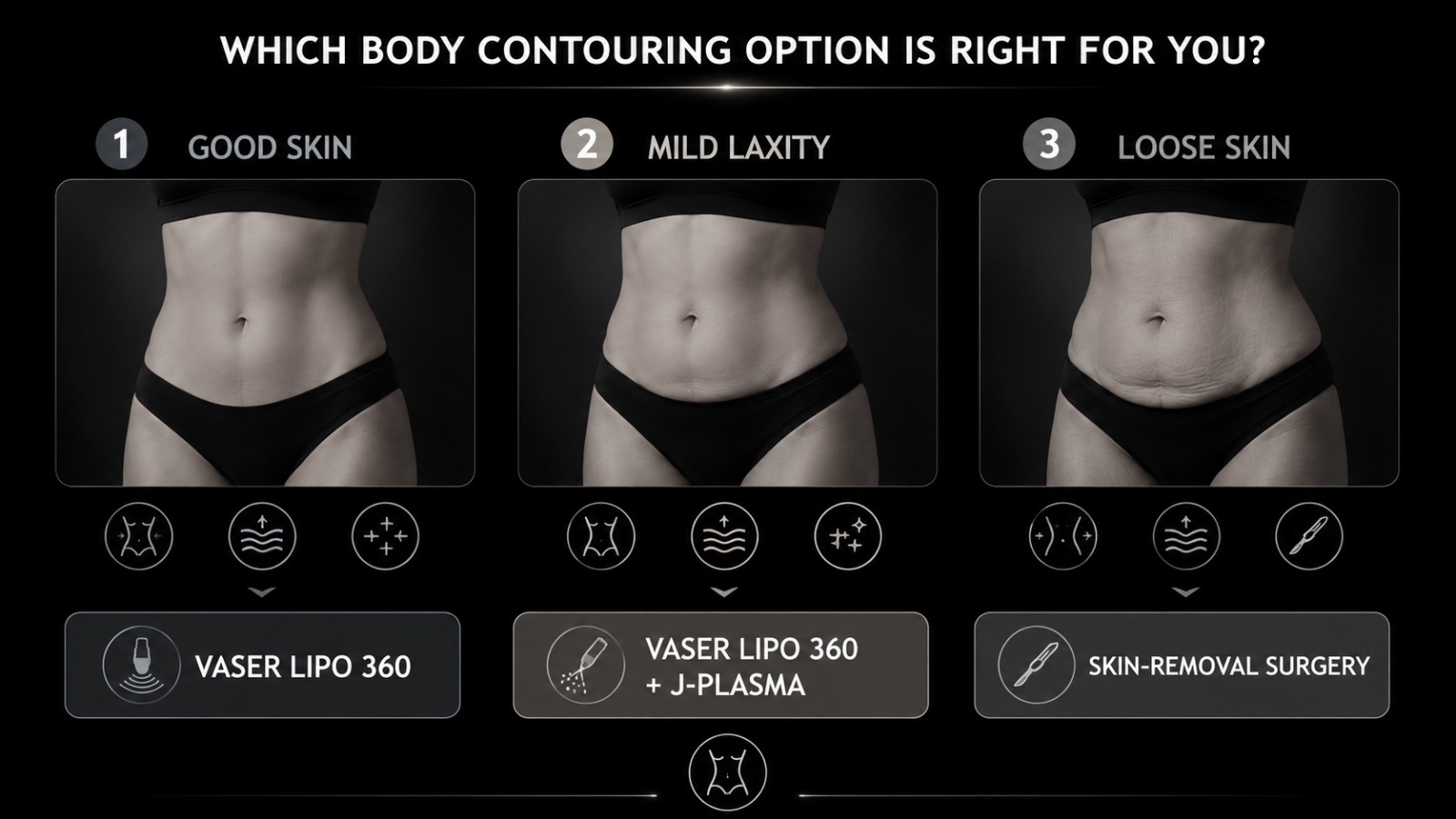
J-Plasma Lipo 360 combines liposuction with J-Plasma, also called Renuvion, for selected patients who have stubborn fat together with mild to moderate skin laxity.
VASER and J-Plasma have different jobs:
But revision is never just “do more liposuction.” Sometimes the answer is fat removal. Sometimes it’s release of fibrosis. Sometimes it’s fat grafting into dents. Sometimes a combination. VASER is a helpful tool in that process — the plan is what determines the outcome.
- VASER helps loosen and prepare the fat
- Liposuction removes the fat.
- J-Plasma supports additional contraction of the tissue under the skin.
The mechanism is genuinely interesting from a technical standpoint — helium-based plasma radiofrequency technology heats subcutaneous fascia and connective tissue directly as the device electrode passes through the subcutaneous layer, which is a different physical process from bulk-heating skin-tightening devices.
J-Plasma may be particularly useful around the back, bra rolls, flanks, love handles, abdomen, and armpit area.
But J-Plasma is not a replacement for removing loose skin. If the patient has significant hanging skin, severe laxity, or major changes after pregnancy or weight loss, a tummy tuck, back lift, or another skin-removal procedure may be more appropriate. I'd rather have that conversation upfront than let a patient expect skin removal from a device that isn't designed to deliver it.
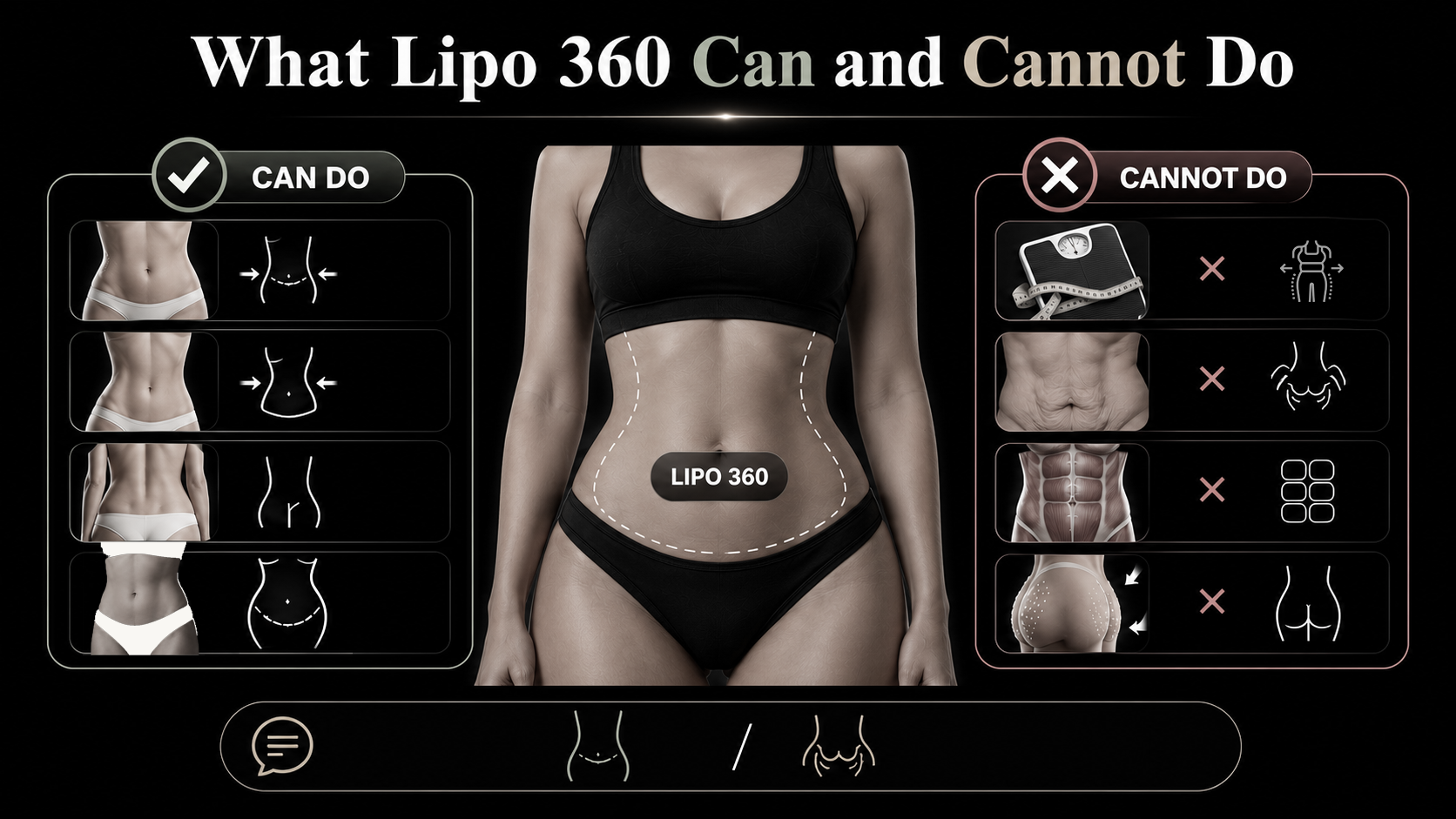
What Lipo 360 Can and Cannot Do?
Loose skin can become more visible after fat removal. If the main problem is skin or muscle separation, liposuction alone may disappoint the patient — which is exactly why I assess this honestly at consultation rather than after the fact.
| Lipo 360 can help with | Lipo 360 cannot |
|---|---|
| Stubborn fat around connected torso areas | Remove visceral fat around the organs |
| A flatter abdomen and smoother back | Repair separated abdominal muscles |
| A smaller female waistline | Remove significant hanging skin |
| Reduced male love handles and stronger V-taper | Change the rib cage, pelvis, or skeleton |
| Better torso proportion from every angle | Replace weight loss or a healthy lifestyle |
Who Is a Good Candidate for Lipo 360?
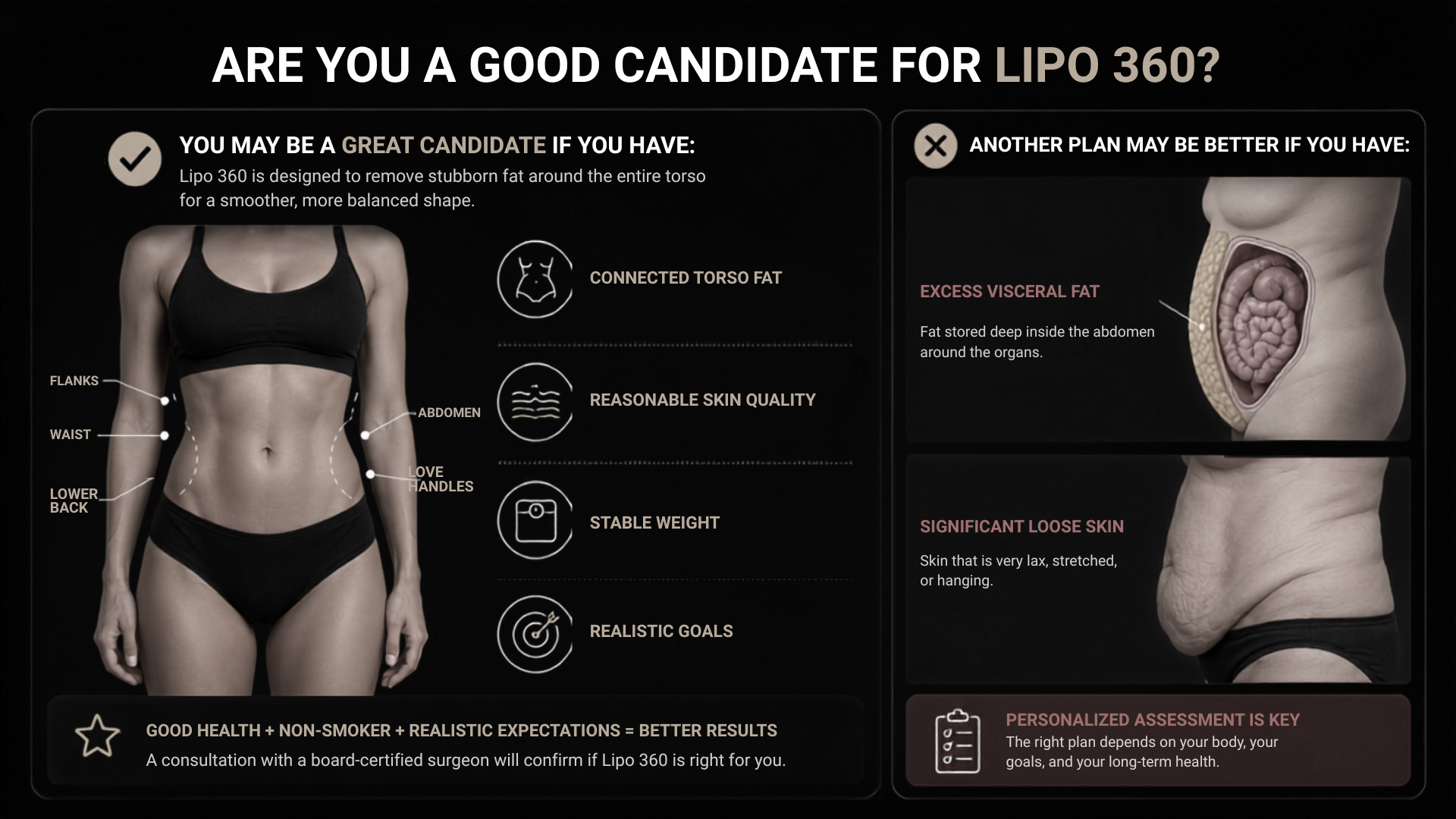
A good candidate usually has:
- Stubborn fat around several connected areas of the torso
- Reasonably good skin quality
- Stable or near-stable weight
- Good general health
- Realistic expectations
- A desire for improved shape rather than major weight loss
- A commitment to garments, massage, follow-up, and maintaining the result
During consultation, I assess fat thickness, skin laxity, visceral fat, muscle separation, previous surgery, scars, body proportions, and whether the patient wants slimming or definition
Sometimes Lipo 360 is the right answer. Sometimes the honest answer is weight loss, tummy tuck, J-Plasma, or a smaller procedure. I'd rather tell a patient that than perform an operation I know won't deliver what they're actually looking for.
Lipo 360 vs Tummy Tuck
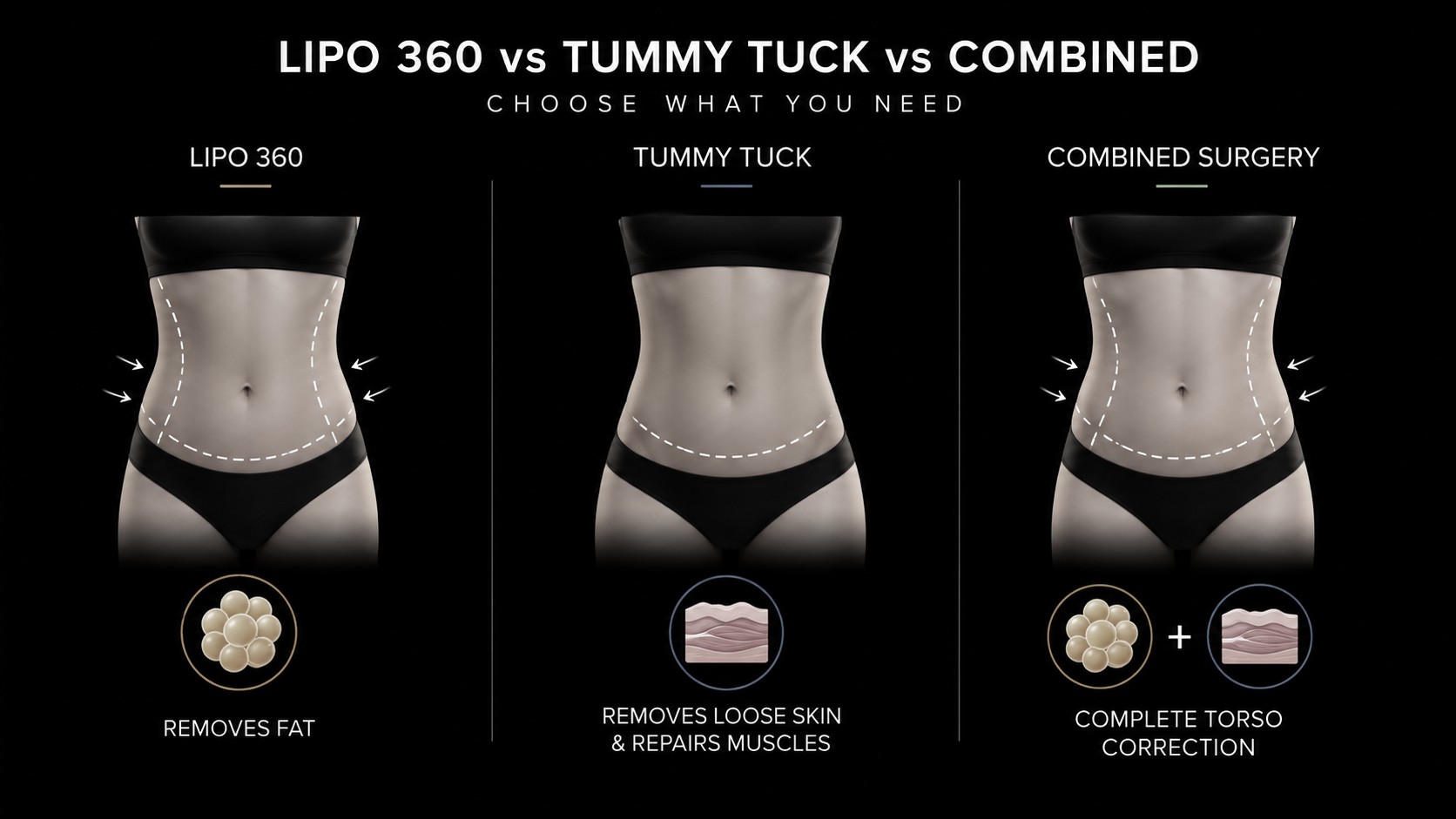
Lipo 360 removes fat. A tummy tuck removes loose abdominal skin and can repair separated muscles. They solve different problems.
| Lipo 360 may be enough when | A tummy tuck may be needed when |
|---|---|
| Skin quality is reasonably good | Skin hangs over the lower abdomen |
| The main problem is stubborn fat | There is significant skin laxity |
| There is no major muscle separation | The abdominal muscles are separated |
| There is no lower abdominal apron | The belly button and lower abdomen need reconstruction |
Some patients need a tummy tuck in front with VASER Lipo 360 around the waist, flanks, and back. This is common in post-pregnancy body contouring.
Can Lipo 360 Be Combined With Fat Transfer or Other Surgery?
Yes, in selected patients.
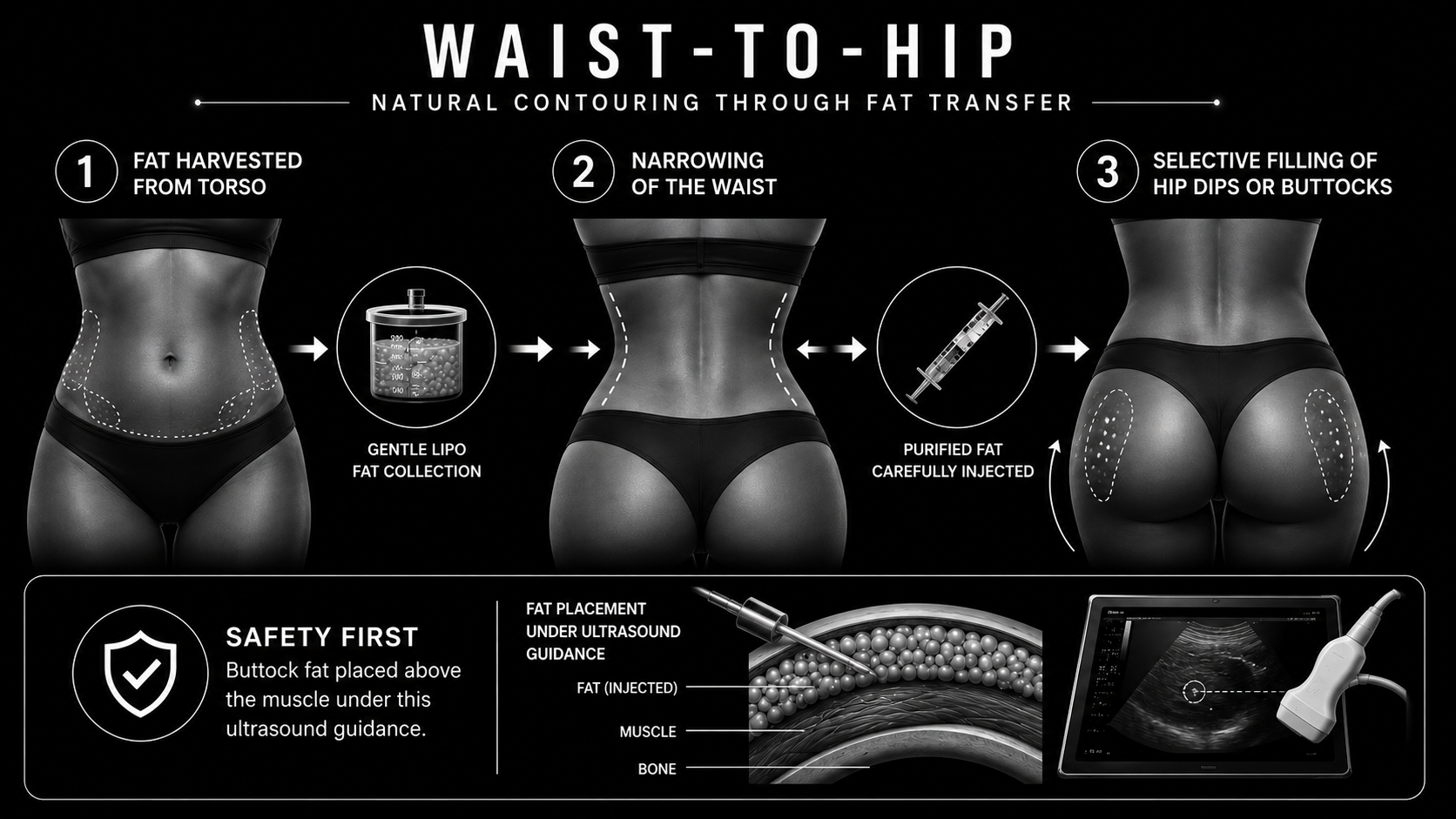
Fat removed during Lipo 360 can be processed and transferred to hip dips, the lateral buttocks, the upper buttocks, or the entire buttock shape in selected patients. Narrowing the waist and lower back can also make the buttocks look more proportionate even before any fat is transferred.
When buttock fat transfer is performed, my safety rule is strict: the fat is placed above the buttock muscle, under ultrasound guidance. This is not a preference I'll compromise on. Gluteal fat transfer performed incorrectly carries the highest reported mortality risk of any aesthetic procedure, and the risk of fatal fat embolism is specifically tied to intramuscular rather than subcutaneous placement — which is exactly why the plane of injection is the single most important safety decision in that procedure.
Lipo 360 can also be combined with a tummy tuck, extended tummy tuck, mommy makeover body contouring, cellulite correction, or male chest contouring when the total surgery remains safe.
Breast augmentation or reduction may be part of a broader transformation, but breast surgery is not part of my own practice. If needed, it may be performed by an appropriate breast surgeon and may need to be staged depending on the total operating time and safety.
I don't believe doing the maximum number of procedures in one sitting is automatically better. A safe staged plan beats an overambitious single operation every time.
How Is Lipo 360 Performed?
Step 1: Consultation and assessment
I assess the patient from the front, side, and back. I examine fat distribution, waistline, upper and lower abdomen, flanks, back folds, skin quality, visceral fat, muscle separation, previous scars, and previous liposuction.
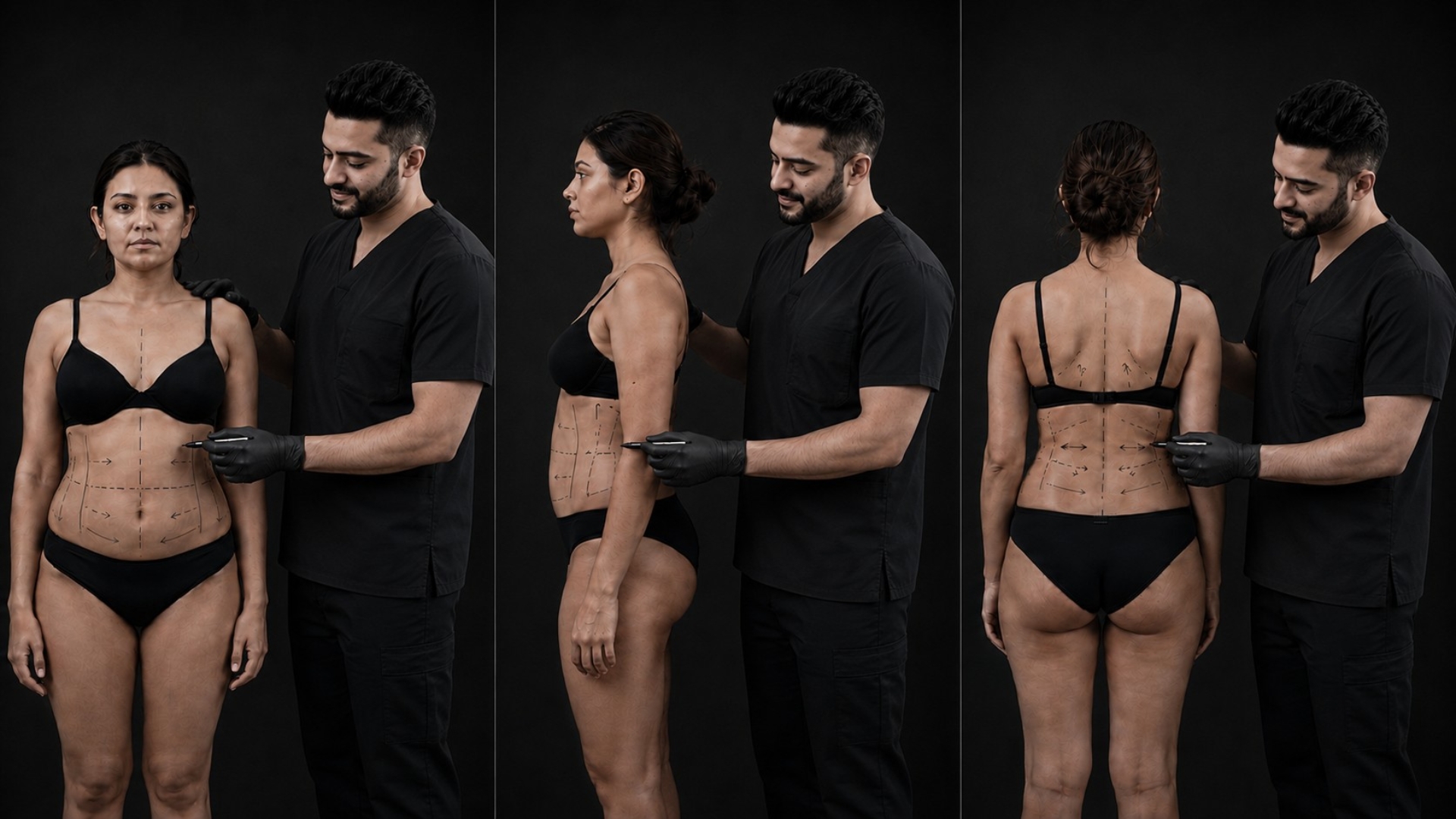
Step 2: Standing markings
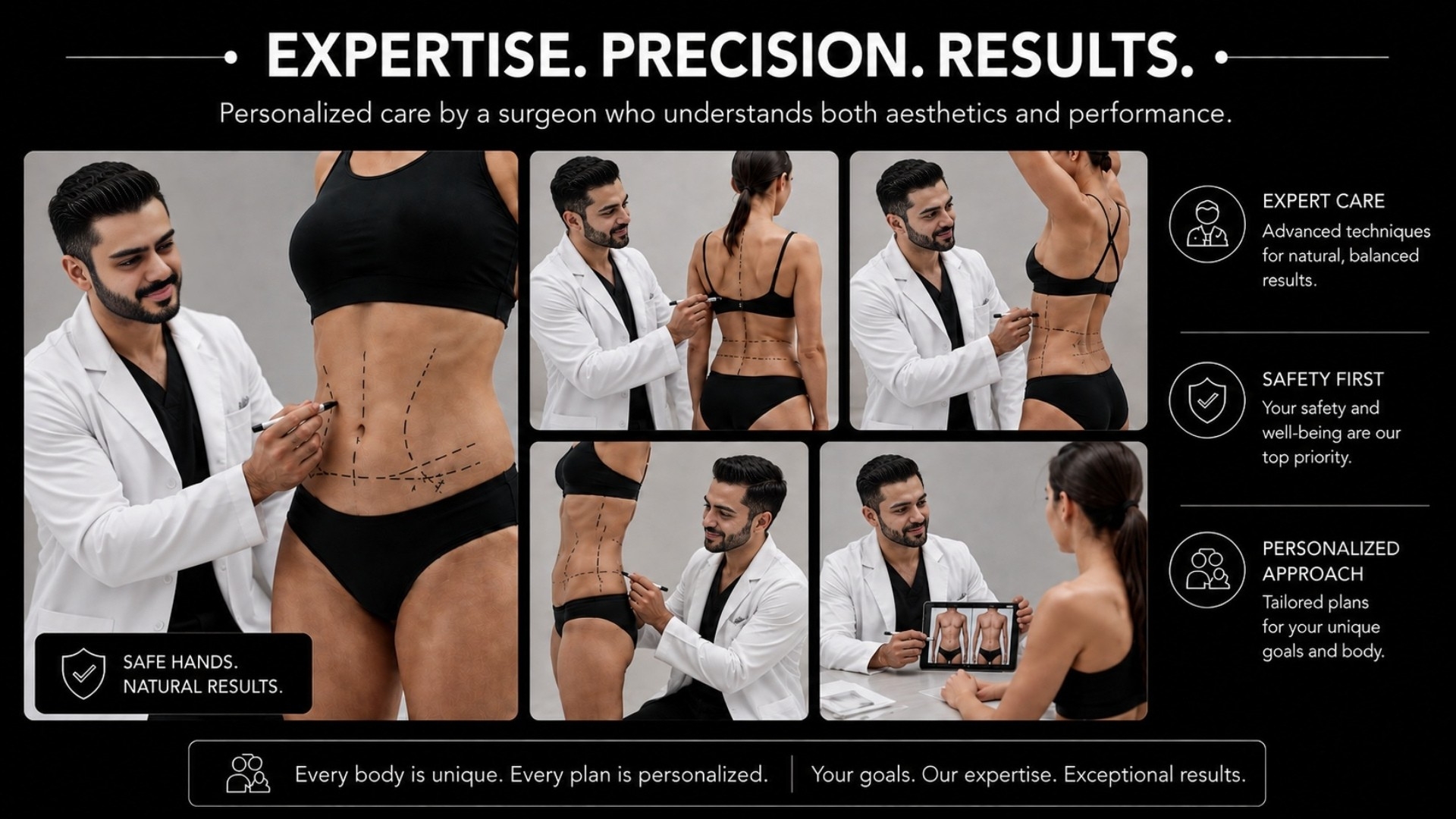
Marking is done while the patient is standing. Fat folds can disappear or shift when a patient lies down, so I want to see the real shape before surgery.
Step 3: Anaesthesia
Comprehensive Lipo 360 is usually performed under general anaesthesia because several areas and more than one patient position may be involved.
Step 4: Fluid Infiltration
A special fluid is placed into the fat layer to reduce bleeding, improve comfort, and prepare the tissue.
Step 5: VASER emulsification
When VASER is used, ultrasound energy loosens the fat before removal.
Step 6: Fat aspiration and contouring
The fat is removed with cannulas. Different areas need different levels of reduction. The waist may need more shaping, while certain transitions need some fat preserved to avoid dents or an artificial result.
Step 7: J-Plasma when required
If mild to moderate skin laxity is present, J-Plasma may be used after fat removal for additional tissue contraction.
Step 8: Incision closure and drainage
Most incisions are closed with internal stitches. Some low incisions may be left open temporarily so fluid can drain during the first day or two.
Step 9: Garment, foams, and aftercare
A compression garment is placed immediately after surgery. Foam pads or other compression aids may be added depending on the areas treated.
Where Are the Lipo 360 Incisions?
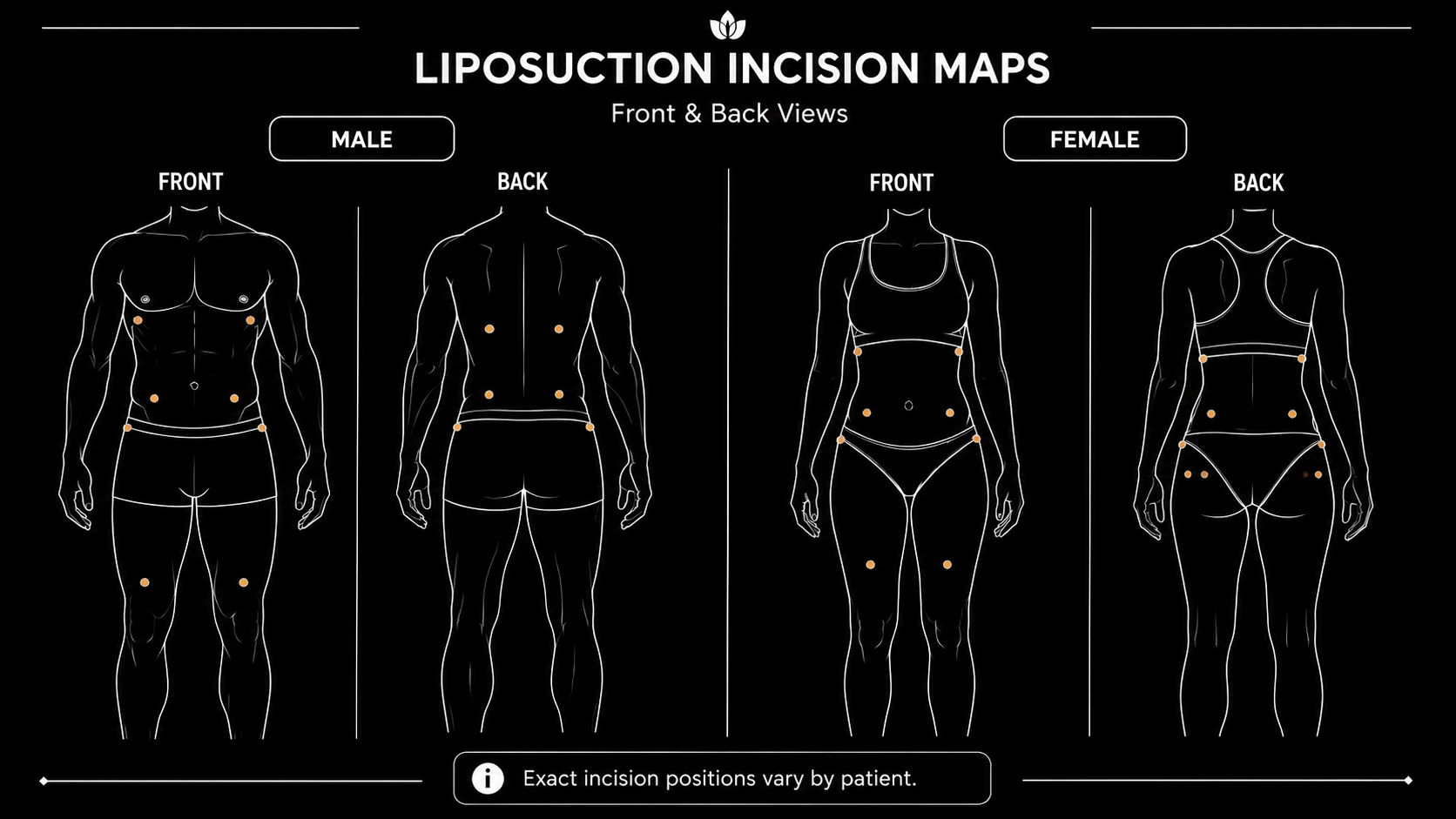
Lipo 360 uses several small access points because I need to reach the torso from different directions. I place the incisions in hidden or discreet areas whenever possible.
Common incision areas in men:
- Around the nipple-areola border for chest access
- Above or inside the belly button
- In the bikini line or groin crease
- Just above the buttock crease or sacral area
- Along the sides of the back
- Near the axilla for upper-back access
Common incision areas in women:
- In the breast fold when access is needed
- Above or inside the belly button
- In the bikini line or groin crease
- Just above the buttock crease or sacral area
- Along the middle or sides of the back
- Near the axilla for upper- and middle-back access
The number and position of incisions depend on the anatomy and surgical plan. Most marks are small, but every incision can leave a scar. Placement matters, especially in patients who develop dark or raised scars.
Procedure Duration, Anaesthesia, and Hospital Stay
| Detail | Typical guidance |
|---|---|
| Procedure duration | Approximately 2.5 to 3.5 hours for standard Lipo 360 |
| Anaesthesia | Usually general anaesthesia |
| Hospital stay | Day-care in selected cases; one night for larger or combined procedures |
| Longer procedures | High-definition work, revision tissue, J-Plasma, male chest treatment, or fat transfer may add time |
The exact time depends on the number of areas, volume and density of fat, male or female treatment plan, VASER, J-Plasma, revision tissue, and whether fat transfer is added.
I follow accepted large-volume liposuction standards on this closely. Large-volume liposuction, generally defined as more than 5,000cc of total aspirate, should be performed in an acute-care hospital or an accredited facility with staff experienced in large-volume liposuction care, and overnight monitoring is standard practice above that threshold. This isn't a preference I apply loosely — it's a line I don't cross regardless of how a patient feels about the extra night.
Recovery and Downtime After Lipo 360
Lipo 360 is a bigger recovery than treating one very small area because the soreness surrounds the torso.
Patients commonly feel sore, tight, swollen, bruised, stiff, numb in areas, and uncomfortable while turning in bed or standing up.
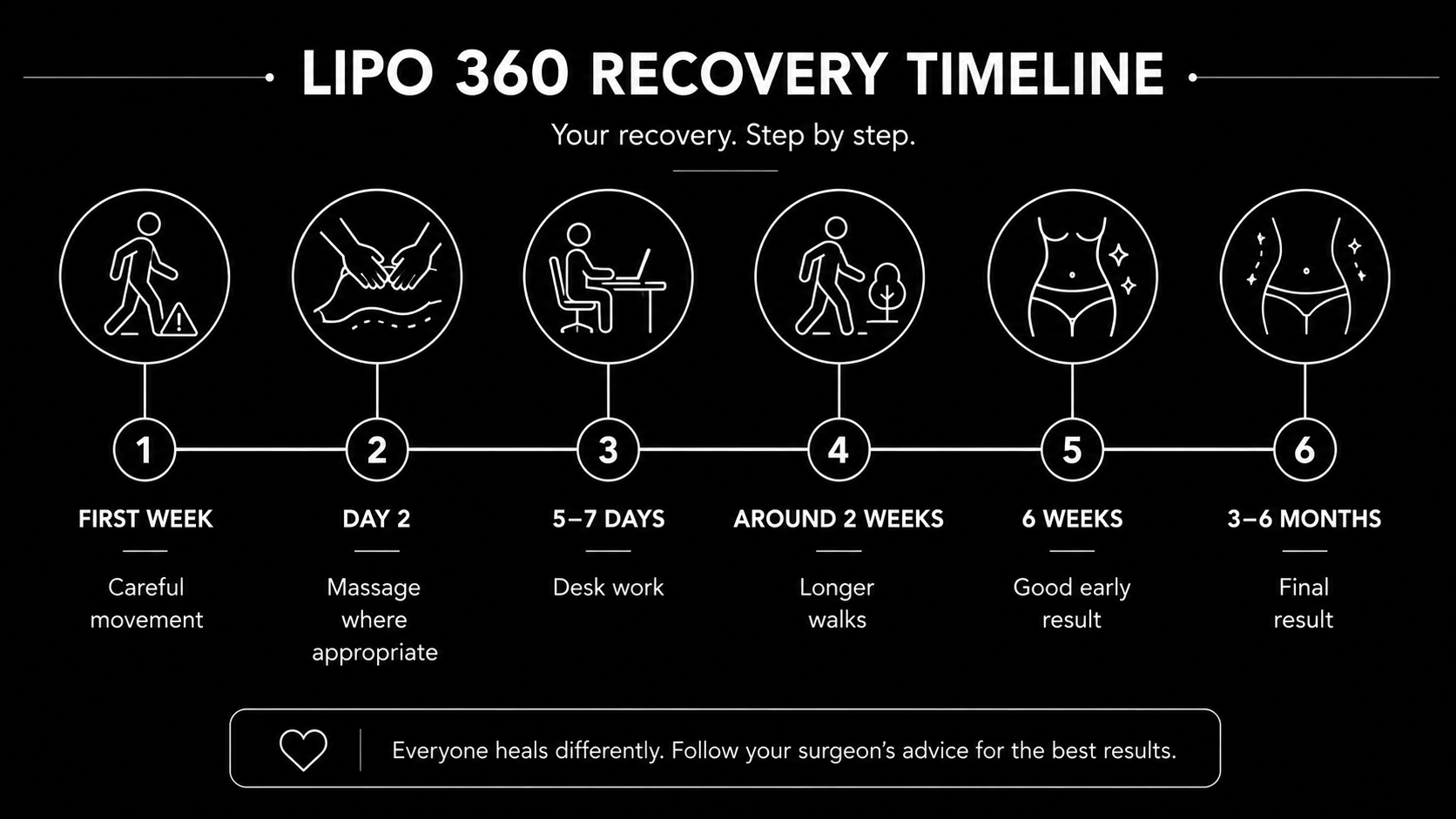
For the first week, I ask patients to move slowly and deliberately. That doesn't mean staying in bed all day. Short, regular walks are important, but unnecessary bending, twisting, lifting, and sudden movements can make the first week more painful.
Most patients can work from home or return to desk work after around 5 to 7 days, depending on the extent of surgery and the type of work. Longer walks or treadmill walking usually begin around two weeks. Gym and heavier exercise return gradually after review.
| Recovery stage | What to expect |
|---|---|
| Days 1-7 | Soreness, drainage, bruising, swelling, careful movement, short walks |
| Weeks 1-2 | Swelling may increase or fluctuate; desk work often possible |
| Weeks 3-6 | Waist and torso shape become more visible |
| Months 3-6 | Most swelling settles and final contour becomes clearer |
Managing Pain, Swelling, and Bruising:
Pain
Most patients describe Lipo 360 pain as deep soreness, burning, tightness, or the feeling of having
completed a very intense workout. The first few days are the most uncomfortable. I prescribe pain medication and
advise patients to stay ahead of the discomfort. Rolling out of bed carefully, avoiding sudden twisting, and asking
for help during the first few days can make recovery easier.
Swelling
Swelling is expected. It often increases or fluctuates during the first one to two weeks before gradually
reducing. The back and flanks may remain swollen longer than patients expect.
"My waist looked smaller last week. Why do I look swollen again?"
Swelling can change with activity, long periods of sitting, heat, menstrual cycle, salt intake, garment pressure, massage, and individual healing.
Bruising
Bruising is common, especially around the abdomen, flanks, lower back, chest, and areas where the fat
is dense. I may advise selected patients to use Arnica or Hirudoid gel when it is safe to apply and away from open
incisions.
Severe worsening pain, shortness of breath, calf pain, fever, redness, or one-sided swelling needs medical review.
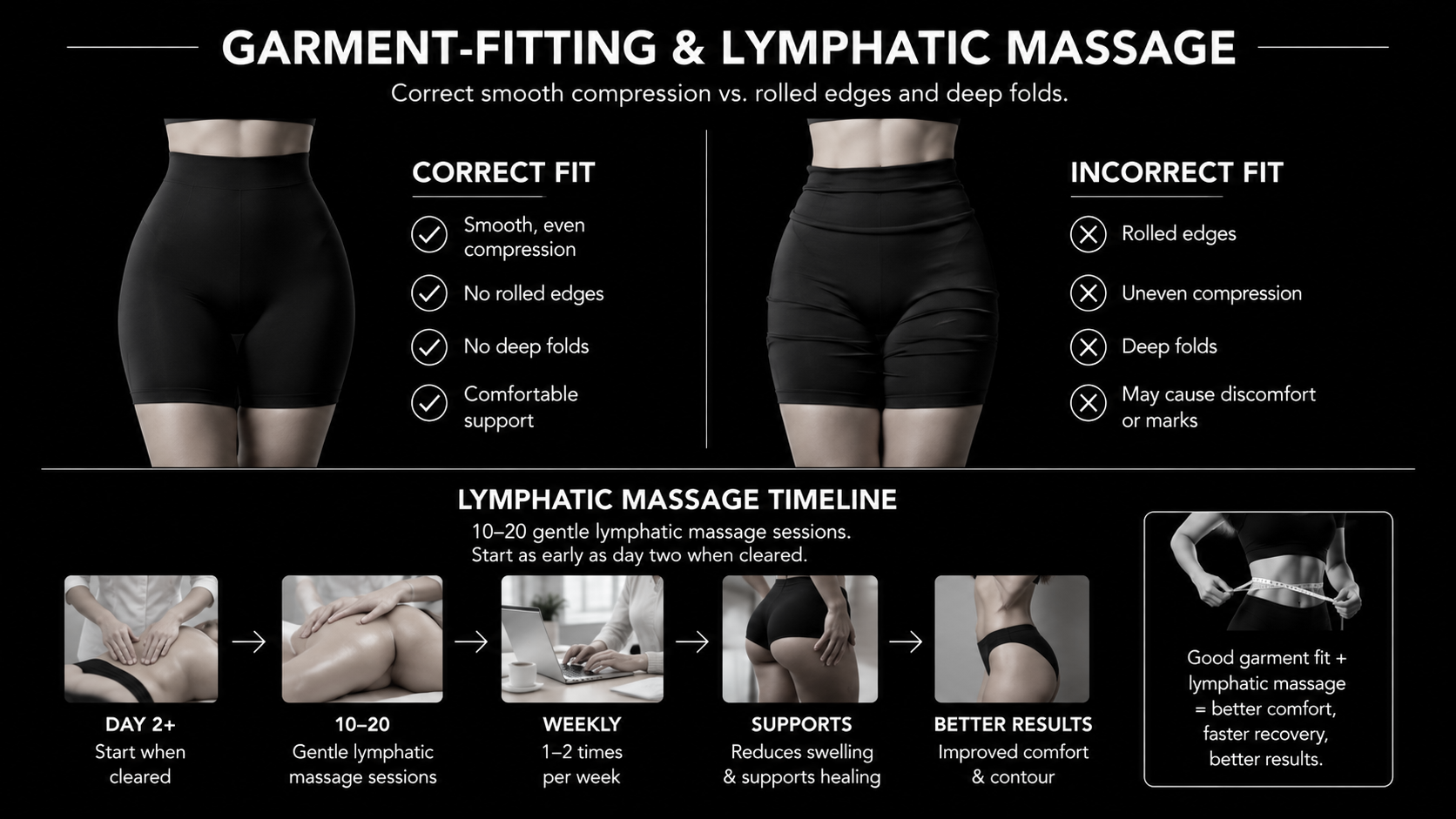
Compression Garments and Lymphatic Massage
Compression garments.
In my practice, patients usually wear the garment continuously for at least six weeks,
removing it for showers and garment washing. Some patients may continue compression for two to three months,
especially when swelling persists, J-Plasma was used, the procedure was extensive, or the garment makes the
torso feel more supported.
A tighter garment is not always a better garment. If it folds, digs into the skin, causes severe pain, breathing restriction, numbness, or deep pressure lines, it needs to be reviewed.
Lymphatic massage.
I start lymphatic massage as early as day two after Lipo 360, depending on comfort and
the surgical plan. Most patients need at least 10 sessions. Some benefit from 15 to 20, especially after larger
procedures or when the back remains swollen or firm.
The massage should be gentle and performed by someone trained in post-liposuction care. More pressure does not mean a better massage.
When Will I See the Result?
The result appears gradually.
- First week: swelling, bruising, soreness, stiffness, and fluid drainage
- Two weeks: better mobility, but swelling may still be prominent and uneven
- Four to six weeks: the waist and torso shape become more visible
- Three to six months: the majority of swelling settles and the tissues soften
- Beyond six months: revision and J-Plasma cases may continue improving
Do not judge a Lipo 360 result during the first few weeks. Swelling can temporarily hide the waist and make one side look different from the other.
| Procedure | Approximate cost |
|---|---|
| VASER Lipo 360 | Starting from AED 38,000 |
| VASER Lipo 360 with J-Plasma | Starting from AED 40,000 |
Lipo 360 Cost in Dubai
Pricing depends on the male or female treatment plan, areas included, volume and density of fat, VASER, J-Plasma, high-definition sculpting, revision surgery, fat transfer, and hospital stay.
These are approximate ranges. The final quotation is confirmed after examination because two patients asking for "Lipo 360" may need very different operations.
Risks and Possible Side Effects
Lipo 360 is still surgery.
Temporary effects can include swelling, bruising, soreness, tightness, numbness, fluid leakage, firmness, lumpiness, and uneven swelling.
Possible complications include infection, bleeding, seroma, contour irregularities, asymmetry, loose skin, pigmentation changes, scarring, burns from energy devices, delayed healing, blood clots, fat embolism, and the need for revision surgery.
I want to give both my patients and the colleagues reading this an honest, evidence-grounded picture rather than a reassuring one. The overall incidence of venous thromboembolic events after liposuction is low, at approximately 0.03 percent, and pulmonary embolism remains the leading cause of death associated with the procedure. Larger published series report complication rates in the range of 0.9 to 1.5 percent, with both patient BMI and the volume of fat removed per unit of BMI identified as independent risk factors. This is exactly why I don't chase volume for its own sake, and why staging matters more than most marketing around this procedure admits.
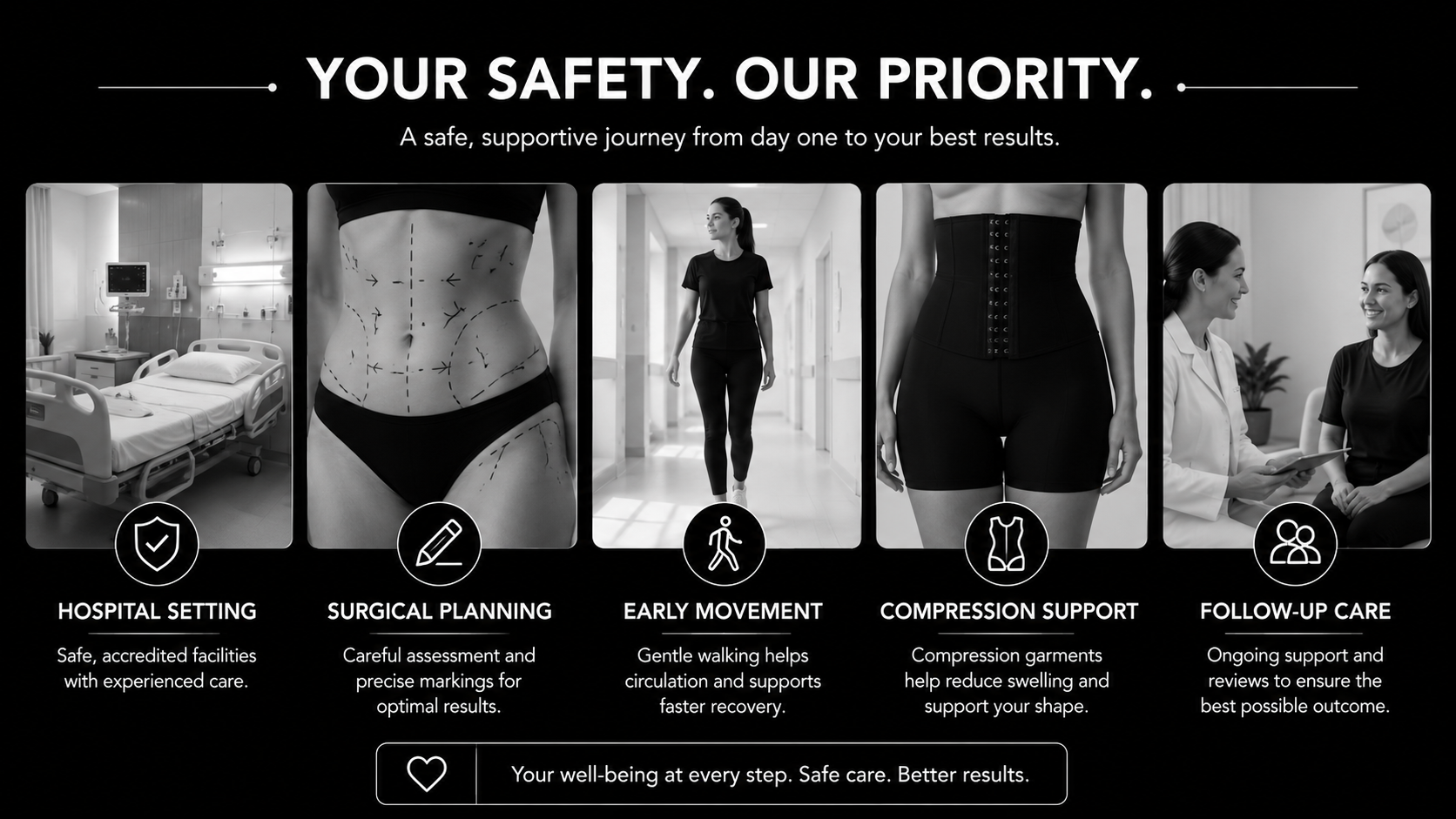
The answer isn't to pretend these risks don't exist. The answer is proper patient selection, hospital-based surgery, safe anaesthesia, controlled fat removal, early walking, careful follow-up, and disciplined aftercare.
Why Choose Dr. Hardik Ganatra for Lipo 360 in Dubai?
Body contouring isn't one of the things I do. It's the focus of my practice.
That matters in Lipo 360 because a comprehensive torso result depends on much more than removing fat. I assess the waist from the front, projection from the side, back folds from behind, chest-to-abdomen balance in men, waist-to-hip balance in women, skin quality, muscle structure, and the way the torso looks in movement.
I'm also a recreational natural bodybuilder. Years of training have taught me how a lean, fit, muscular physique should look — not only standing still, but moving, turning, flexing, and relaxing. That understanding shapes how I plan male and female torso contouring.
My practice is built around four principles:
- Exclusive focus on body contouring
- Safe surgical practice combined with excellent aesthetic results
- Structured and attentive post-operative care
- Honest and ethical guidance, including telling a patient when Lipo 360 is not the right operation
I work with VASER liposuction, high-definition liposuction, J-Plasma, revision liposuction, tummy tuck, fat transfer, and post-weight-loss body contouring. This lets me choose the procedure based on the patient's anatomy, rather than trying to make one technique fit everyone.
Lipo 360
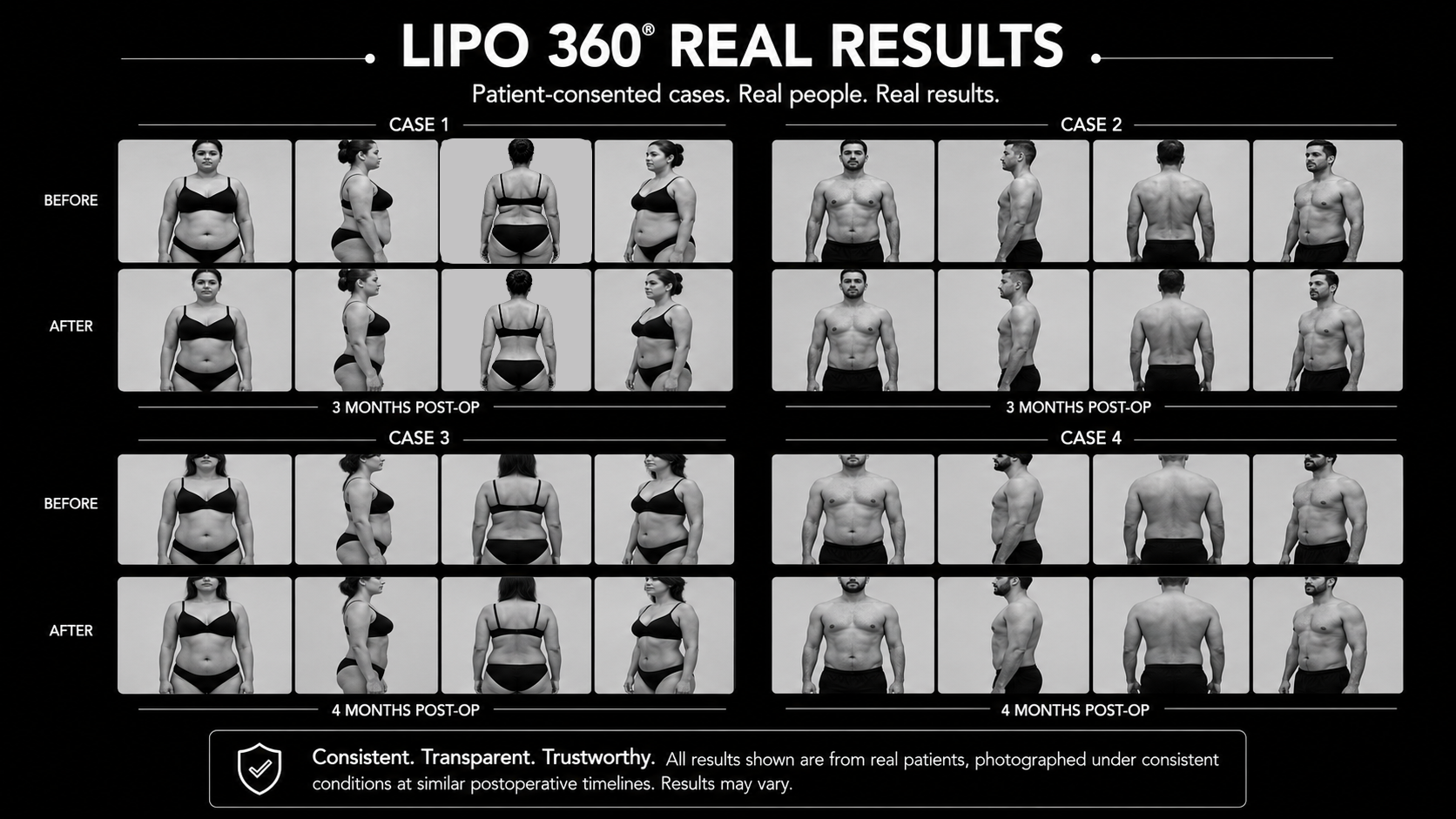
Before & After
View real transformations that showcase natural definition and proportionate shape enhancement. Each result represents thoughtful contouring, not overcorrection.
Frequently Asked Questions Lipo 360 in Dubai
Is liposuction a weight-loss surgery?
No. I explain this very clearly during consultation. Liposuction is for contouring, not weight loss. It removes fat under the skin and improves shape; it does not replace diet, exercise, or medical weight management.
Who is a good candidate for liposuction?
I look for stubborn fat deposits, reasonable skin quality, stable weight, good health, and realistic expectations. If the problem is loose skin or visceral fat, liposuction alone may not be the right answer.
Can liposuction remove visceral belly fat?
No. Liposuction removes subcutaneous fat — the fat under the skin. Visceral fat sits deeper, around the organs, and needs weight loss and lifestyle management.
What is VASER liposuction?
VASER uses ultrasound energy to soften fat before removal. I use it when it genuinely helps — especially in fibrous areas, high-definition cases, revision liposuction, and body sculpting.
Does VASER liposuction tighten skin?
VASER may support skin retraction in selected patients, but it is not a skin removal procedure. If the skin is loose, I may discuss J-Plasma, BodyTite, or skin removal surgery.
What is J-Plasma liposuction?
J-Plasma is used after fat removal to help the skin contract in selected patients. I usually consider it when there is mild to moderate skin laxity.
Is J-Plasma or BodyTite worth adding to liposuction?
It can be, if the patient has fat plus mild skin looseness. I don’t use these devices as magic solutions. If the skin is significantly loose, a lift or tummy tuck is the more honest answer.
Can liposuction replace a tummy tuck?
No. Liposuction removes fat. A tummy tuck removes loose skin and repairs muscle separation when needed. If the abdomen has hanging skin or diastasis, liposuction alone will disappoint.
Can liposuction make loose skin worse?
VASER (Vibration Amplification of Sound Energy at Resonance) is an ultrasound-assisted liposuction technique. The ultrasound energy helps loosen fat cells so they can be removed more smoothly through small cannulas.
What is slim-down liposuction?
VASER (Vibration Amplification of Sound Energy at Resonance) is an ultrasound-assisted liposuction technique. The ultrasound energy helps loosen fat cells so they can be removed more smoothly through small cannulas.
What is high-definition liposuction?
VASER (Vibration Amplification of Sound Energy at Resonance) is an ultrasound-assisted liposuction technique. The ultrasound energy helps loosen fat cells so they can be removed more smoothly through small cannulas.
What is Lipo 360?
VASER (Vibration Amplification of Sound Energy at Resonance) is an ultrasound-assisted liposuction technique. The ultrasound energy helps loosen fat cells so they can be removed more smoothly through small cannulas.
How much does liposuction cost in Dubai?
VASER (Vibration Amplification of Sound Energy at Resonance) is an ultrasound-assisted liposuction technique. The ultrasound energy helps loosen fat cells so they can be removed more smoothly through small cannulas.
How much fat can be removed with liposuction?
VASER (Vibration Amplification of Sound Energy at Resonance) is an ultrasound-assisted liposuction technique. The ultrasound energy helps loosen fat cells so they can be removed more smoothly through small cannulas.
Can fat come back after liposuction?
VASER (Vibration Amplification of Sound Energy at Resonance) is an ultrasound-assisted liposuction technique. The ultrasound energy helps loosen fat cells so they can be removed more smoothly through small cannulas.
Why do I look swollen after liposuction?
VASER (Vibration Amplification of Sound Energy at Resonance) is an ultrasound-assisted liposuction technique. The ultrasound energy helps loosen fat cells so they can be removed more smoothly through small cannulas.
When will I see my final liposuction result?
VASER (Vibration Amplification of Sound Energy at Resonance) is an ultrasound-assisted liposuction technique. The ultrasound energy helps loosen fat cells so they can be removed more smoothly through small cannulas.
Is liposuction painful?
VASER (Vibration Amplification of Sound Energy at Resonance) is an ultrasound-assisted liposuction technique. The ultrasound energy helps loosen fat cells so they can be removed more smoothly through small cannulas.
What is the downtime after liposuction?
VASER (Vibration Amplification of Sound Energy at Resonance) is an ultrasound-assisted liposuction technique. The ultrasound energy helps loosen fat cells so they can be removed more smoothly through small cannulas.
How long do I need to wear compression garments after liposuction?
VASER (Vibration Amplification of Sound Energy at Resonance) is an ultrasound-assisted liposuction technique. The ultrasound energy helps loosen fat cells so they can be removed more smoothly through small cannulas.
Are lymphatic massages necessary after liposuction?
VASER (Vibration Amplification of Sound Energy at Resonance) is an ultrasound-assisted liposuction technique. The ultrasound energy helps loosen fat cells so they can be removed more smoothly through small cannulas.
Is it normal to have hard lumps after liposuction?
VASER (Vibration Amplification of Sound Energy at Resonance) is an ultrasound-assisted liposuction technique. The ultrasound energy helps loosen fat cells so they can be removed more smoothly through small cannulas.
What is fibrosis after liposuction?
VASER (Vibration Amplification of Sound Energy at Resonance) is an ultrasound-assisted liposuction technique. The ultrasound energy helps loosen fat cells so they can be removed more smoothly through small cannulas.
Can liposuction cause dents or irregularities?
VASER (Vibration Amplification of Sound Energy at Resonance) is an ultrasound-assisted liposuction technique. The ultrasound energy helps loosen fat cells so they can be removed more smoothly through small cannulas.
Can botched liposuction be fixed?
VASER (Vibration Amplification of Sound Energy at Resonance) is an ultrasound-assisted liposuction technique. The ultrasound energy helps loosen fat cells so they can be removed more smoothly through small cannulas.
When should I consider revision liposuction?
VASER (Vibration Amplification of Sound Energy at Resonance) is an ultrasound-assisted liposuction technique. The ultrasound energy helps loosen fat cells so they can be removed more smoothly through small cannulas.
Can liposuction treat cellulite?
VASER (Vibration Amplification of Sound Energy at Resonance) is an ultrasound-assisted liposuction technique. The ultrasound energy helps loosen fat cells so they can be removed more smoothly through small cannulas.
Can liposuction be done on the arms?
VASER (Vibration Amplification of Sound Energy at Resonance) is an ultrasound-assisted liposuction technique. The ultrasound energy helps loosen fat cells so they can be removed more smoothly through small cannulas.
Can liposuction be done on the thighs?
VASER (Vibration Amplification of Sound Energy at Resonance) is an ultrasound-assisted liposuction technique. The ultrasound energy helps loosen fat cells so they can be removed more smoothly through small cannulas.
Can liposuction be done for lipedema?
VASER (Vibration Amplification of Sound Energy at Resonance) is an ultrasound-assisted liposuction technique. The ultrasound energy helps loosen fat cells so they can be removed more smoothly through small cannulas.
Can liposuction be combined with fat transfer?
VASER (Vibration Amplification of Sound Energy at Resonance) is an ultrasound-assisted liposuction technique. The ultrasound energy helps loosen fat cells so they can be removed more smoothly through small cannulas.
Is BBL fat injected into the muscle?
VASER (Vibration Amplification of Sound Energy at Resonance) is an ultrasound-assisted liposuction technique. The ultrasound energy helps loosen fat cells so they can be removed more smoothly through small cannulas.
Are liposuction scars visible?
VASER (Vibration Amplification of Sound Energy at Resonance) is an ultrasound-assisted liposuction technique. The ultrasound energy helps loosen fat cells so they can be removed more smoothly through small cannulas.
Why is fluid leaking after liposuction?
VASER (Vibration Amplification of Sound Energy at Resonance) is an ultrasound-assisted liposuction technique. The ultrasound energy helps loosen fat cells so they can be removed more smoothly through small cannulas.
When can I return to work after liposuction?
VASER (Vibration Amplification of Sound Energy at Resonance) is an ultrasound-assisted liposuction technique. The ultrasound energy helps loosen fat cells so they can be removed more smoothly through small cannulas.
When can I exercise after liposuction?
VASER (Vibration Amplification of Sound Energy at Resonance) is an ultrasound-assisted liposuction technique. The ultrasound energy helps loosen fat cells so they can be removed more smoothly through small cannulas.
Why do some people regret liposuction?
VASER (Vibration Amplification of Sound Energy at Resonance) is an ultrasound-assisted liposuction technique. The ultrasound energy helps loosen fat cells so they can be removed more smoothly through small cannulas.
How do I maintain liposuction results?
VASER (Vibration Amplification of Sound Energy at Resonance) is an ultrasound-assisted liposuction technique. The ultrasound energy helps loosen fat cells so they can be removed more smoothly through small cannulas.
How do I know which liposuction technique is right for me?
VASER (Vibration Amplification of Sound Energy at Resonance) is an ultrasound-assisted liposuction technique. The ultrasound energy helps loosen fat cells so they can be removed more smoothly through small cannulas.
Book a Consultation for VASER Liposuction in Dubai
If you’re considering VASER liposuction in Dubai, the first step is a proper consultation — not choosing a machine name or a procedure off a trending list.
During the consultation, I assess fat distribution, skin quality, body goals, previous surgeries, fibrosis, and whether VASER genuinely makes sense for your anatomy. The plan is built around what your body actually needs. The technology follows the plan — not the other way around.
Book a consultation with Dr. Hardik Ganatra to understand whether VASER liposuction is the right option for your anatomy and goals.
Medical Disclaimer
The information on this page is for general educational purposes only and should not be taken as personal medical advice. Every patient has a different anatomy, medical history, and set of goals.
A consultation with Dr. Hardik Ganatra is necessary before deciding whether VASER liposuction is suitable for you. The final treatment plan is determined after a full in-person assessment.
Results vary from patient to patient. No surgical or non-surgical procedure can guarantee a specific result.