
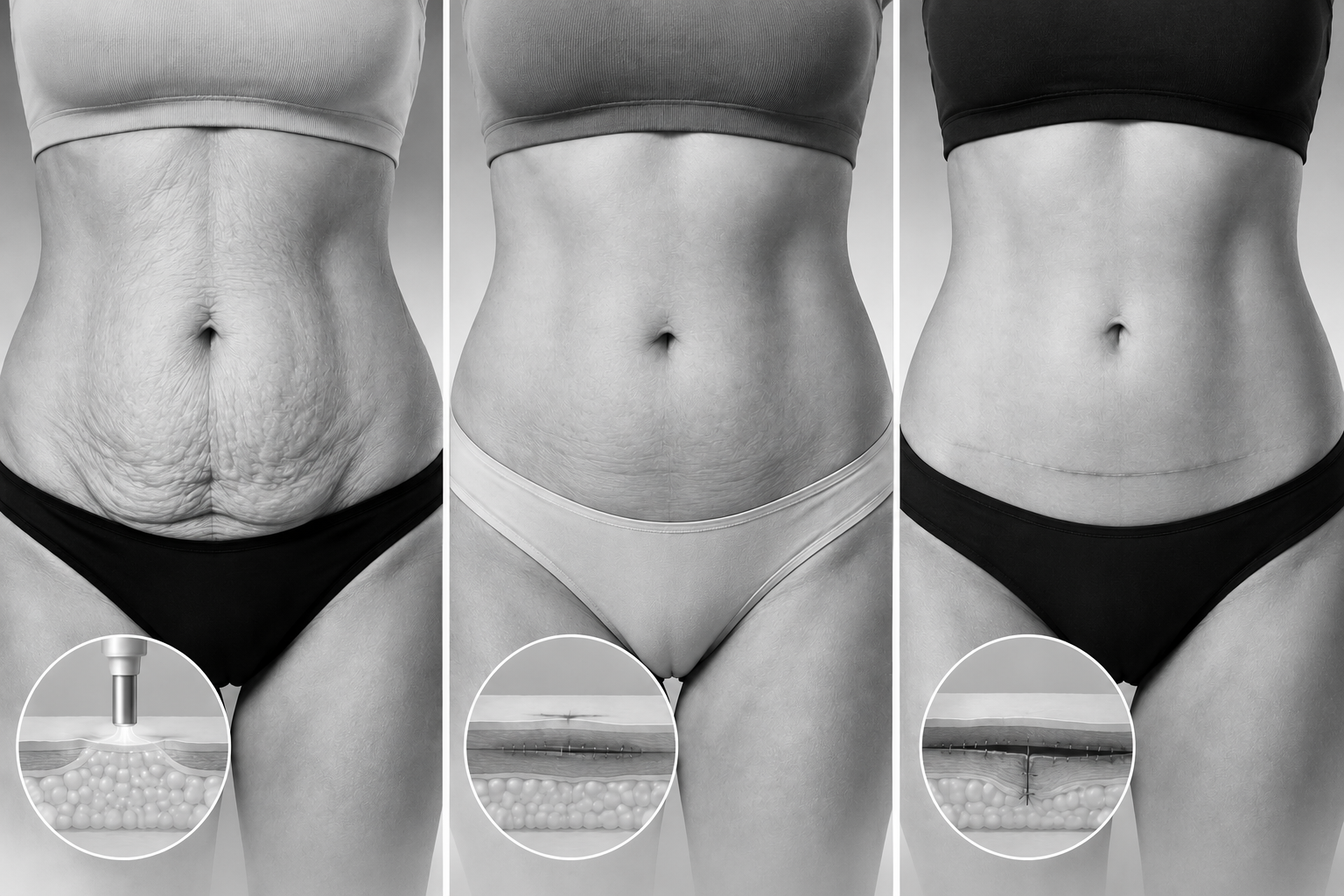
Loose Skin After Liposuction: J-Plasma, Mini Tummy Tuck, or Full Tummy Tuck?
How I Actually Decide What’s Going On Under Your Skin
"Doctor, can J-Plasma fix this, or do I actually need a tummy tuck?"
I get asked some version of this almost every week — usually by a patient standing in front of a mirror, pinching a fold of abdominal skin that either wasn’t there before liposuction, or was there all along and simply got more obvious once the fat stopped hiding it.
Here’s my honest answer, and I’m not going to dress it up: it depends. Not on what you’d prefer to hear, not on whichever device is trending on Instagram this month, but on what’s actually happening underneath your skin. And figuring that out takes more than a glance and a guess — mine, or yours.
Before I recommend anything, I need to know whether the laxity was there before liposuction or turned up after it, whether the previous procedure removed too much fat too close to the skin, whether you’ve lost more weight since, and exactly where on the abdomen we’re talking about. I also need to rule out the impostors — fibrosis, residual fat, muscle separation, even a hernia — because “loose skin” is the diagnosis patients give themselves, and it isn’t always the correct one.
Once I’ve actually worked through that, the choice between J-Plasma, a mini tummy tuck, and a full tummy tuck stops being a guessing game and starts being fairly obvious.
QUICK GUIDE
Mild laxity, decent skin quality → J-Plasma might genuinely be enough.
Excess skin mostly below the belly button → mini tummy tuck.
Loose skin above and below the belly button, often with muscle separation → full tummy tuck.
What I'm Actually Looking At
|
What I find on examination
|
Where that usually leads
|
|---|---|
|
Mild skin laxity, genuinely good skin quality
|
|
|
Loose skin mainly below the belly button
|
Mini tummy tuck
|
|
Loose skin above and below the belly button
|
Full tummy tuck
|
|
Loose skin with significant muscle separation
|
Full tummy tuck with muscle repair
|
|
Loose skin extending onto the flanks
|
Extended tummy tuck
|
|
Loose skin continuing around the back
|
Body lift / circumferential procedure
|
|
Isolated upper-abdominal laxity
|
Reverse tummy tuck, in selected patients
|
|
Loose skin with dents, fibrosis or tethering
|
Revision surgery — scar release, fat grafting or corrective lipo
|
Consider this a cheat sheet, not a prescription. The real answer comes from an actual examination — not a table on the internet, however well-organised.
The 10 Questions I Ask Before I Touch Anything
1. Was the loose skin there before we even started?
This is always my first question, and patients are often surprised by it. Liposuction gets blamed for problems it didn’t actually cause far more often than you’d expect. Pregnancy, major weight loss, repeated weight cycling, simple ageing, and yes — rapid weight loss courtesy of Ozempic or Mounjaro — can all leave skin with noticeably less elasticity than it had a decade ago.
Before surgery, that loose skin had a layer of fat sitting underneath it like padding, propping it up and quietly disguising the problem. Take the fat away, and the disguise goes with it. In these cases, liposuction isn’t the villain — it just turned the lights on. And removing more fat absolutely will not fix this. It’ll just leave the abdomen looking more deflated, which is the opposite of what anyone signs up for.
2. Was the original liposuction too aggressive?
More fat removed does not automatically mean a better result — that’s a lesson some patients learn only after the fact. The skin needs an even, smooth layer of tissue underneath it to lie flat. Take fat too close to the surface, and you end up with an abdomen that’s thin, wrinkled, tethered in places and dented in others — more topography lesson than smooth stomach.
The telltale signs I look for:
- Visible dents or depressions
- Cannula tracks you can actually see
- Sharp transitions between treated and untreated areas
- Skin that looks tethered or stuck down
- Thin patches sitting right beside stubborn bulges
- Irregular folds that masquerade as loose skin
This is no longer a simple skin-tightening problem. J-Plasma won’t fill a dent, and a tummy tuck won’t automatically smooth out an over-suctioned patch. It can take scar release, fat grafting, or careful corrective liposuction — sometimes all three at once.
3. Did you lose more weight after the liposuction?
A great liposuction result isn’t weatherproof against further weight loss. Take away more fat — especially quickly — and the skin envelope that was neatly wrapped around your new shape can loosen up all over again.
So I want the honest answer: are you still actively losing weight, has it genuinely settled, or is there more change still coming? Operating on a body that’s still in motion is how you end up having this conversation twice.
4. How long ago was the liposuction, exactly?
Not everything that looks like loose skin two weeks post-op is loose skin. Swelling resolves at different speeds in different zones. Fibrosis can pull one area inward and create a fold right beside it that has nothing to do with skin laxity. The abdomen can look puffy, uneven, oddly firm or asymmetric while it’s still finding its final shape.
Jumping straight to “you need a tummy tuck” before the tissue has settled is how surgeons end up correcting a problem that was never actually there in the first place.
5. Is this even loose skin?
Patients often use “loose skin” as a catch-all term for almost any abdominal irregularity. The real cause could be fibrosis, adhesions, leftover fat, over-suctioning, uneven swelling, a seroma, muscle separation, or even a hernia.
Each one needs a completely different fix. Massage won’t dissolve residual fat. More liposuction won’t repair a torn muscle wall. J-Plasma can’t fill a divot. And a tummy tuck won’t save the day if the fat layer underneath is still uneven — you’ll just end up with a smoother-looking version of the same problem.
6. Where, exactly, is the loose skin?
Below the belly button only: This is mini-tummy-tuck territory — a limited skin excision through a low, easily hidden scar, sometimes with light work on the lower abdominal wall. What it won’t do is fix anything above the belly button. Choosing this purely because you want the “smaller scar,” when your upper abdomen also needs work, is how you end up back in my office eighteen months later asking why the top half still looks exactly the way it did before.
Above and below the belly button: This is full-tummy-tuck country. More skin removed, both halves of the abdomen tightened, the belly button repositioned, and — when required — the abdominal muscles repaired. Yes, the scar is longer. But when the whole abdomen is involved, a smaller operation just buys you a smaller version of the same disappointment.
Isolated upper abdomen: Less common, but it happens — usually after significant upper-body weight change. In select patients, a reverse tummy tuck (incision hidden beneath the breast fold) can address this without touching the lower abdomen at all.
Extending onto the flanks or around the back: A standard tummy tuck addresses the front of the abdomen. If the laxity wraps around the sides, you’re looking at an extended tummy tuck. If it continues all the way around — common after major weight loss — a body lift or circumferential procedure becomes the honest answer.
7. Is there muscle separation hiding underneath?
Loose skin and rectus diastasis are not the same diagnosis, even though patients often describe them identically. Loose skin is a problem with the outer envelope. Diastasis is a structural problem in the muscle wall underneath it — a different layer entirely.
Tell-tale signs: a rounded, “still pregnant-looking” abdomen, a visible ridge or doming when you sit up, weak core support, or a stomach that stays prominent even though you’re objectively not carrying much fat. J-Plasma has no opinion on muscle separation — it cannot fix it, full stop. I’m also checking for hernias here, particularly if there’s a focal bulge that changes shape when you cough, lift, or tense your abdomen.
8. Is there still excess fat underneath?
Loose skin and residual fat often coexist in the same abdomen — sometimes in the exact same square inch. One part can be over-treated and thin while another remains stubbornly padded — a paper-thin lower abdomen next to flanks that haven’t budged, for example. The plan has to be built area by area: conservative liposuction here, fat grafting there, scar release somewhere else. There’s no single move that fixes the whole canvas at once.
9. What's the actual quality of your skin?
How much skin is loose matters. How good that skin is matters just as much — arguably more. I’m assessing thickness, elasticity, stretch marks, your pregnancy and weight-loss history, age-related changes, smoking history, nutrition, and any prior energy-based treatments.
Healthy skin with mild laxity can genuinely respond well to something less invasive. Thin, heavily stretched skin covered in deep stretch marks isn’t going to perform the same trick, no matter how much we’d both like it to. In body contouring, skin quality isn’t a footnote — it’s half the result.
10. Is the loose skin travelling with other problems?
Loose skin rarely shows up alone. It usually brings friends: dents, residual bulges, tethered skin, fibrotic bands, asymmetry, over-suctioned patches, a belly button that’s drifted off-centre.
In these cases, tightening the skin and calling it a day means treating one symptom and ignoring the rest of the chart. A proper revision plan might include scar release, fat grafting, conservative corrective liposuction, skin excision, belly-button revision, or muscle repair — often more than one of these together.
So — J-Plasma, Mini Tummy Tuck, or Full Tummy Tuck?
When J-Plasma earns its place
- Mild to moderate laxity
- Skin quality is genuinely good
- No large hanging fold of skin
- No major muscle separation
- You understand that “tissue contraction” is a different tool from “removing excess skin” — not a cheaper version of the same one
J-Plasma, also known as Renuvion, is genuinely excellent at what it does — controlled soft-tissue contraction beneath the skin, usually alongside liposuction. What it does not do is replace surgical skin removal once the excess crosses a certain threshold, and it has zero ability to reposition a belly button or repair a torn muscle wall. If someone offers you J-Plasma as a substitute for a tummy tuck you clearly need, that’s a sales pitch, not a treatment plan.
When a mini tummy tuck makes sense
- Excess skin is mainly below the belly button
- Upper abdomen is still reasonably firm
- Muscle laxity, if any, is limited to the lower abdomen
- Belly button already sits in a favourable position
- The redundant skin is modest, not dramatic
A mini tummy tuck is the right call only when the problem is genuinely contained. Ask for one when your case actually calls for the full version, and you’ll get a smaller correction for a smaller problem — except your problem was never the smaller one to begin with.
When a full tummy tuck is the honest answer
- Loose skin affects the upper and lower abdomen
- Skin redundancy is significant
- The belly button needs repositioning
- Rectus diastasis needs repair
- Pregnancy or major weight loss has stretched the abdomen substantially
- Liposuction alone would leave — or worsen — the laxity
Yes, the scar is longer. But “longer and correct” beats “shorter and incomplete” every single time I’ve measured it against how patients feel about their results a year out. The decision should be driven by your anatomy, not by how much scar you’d like to pretend doesn’t exist.
The Treatment Follows the Cause — Not the Other Way Around
When someone walks in with loose skin after liposuction, my job is to work out why their abdomen looks the way it does — before I mention a single treatment option.
Was the skin already loose before surgery, or did liposuction simply expose it? Was the fat removed too aggressively the first time around? Has more weight come off since? Is this confined to the lower abdomen, or does it involve the upper abdomen, flanks and back as well? Is there muscle separation, fibrosis, tethering, or fat sitting unevenly underneath?
Every one of those questions changes the answer. That’s not me being difficult — that’s me refusing to hand you a generic solution to a problem I haven’t properly diagnosed yet.
J-Plasma can do real work for the right patient with mild-to-moderate laxity and good skin quality. A mini tummy tuck earns its keep when the issue is genuinely confined below the belly button. A full tummy tuck becomes the honest answer once the upper and lower abdomen are both involved, or once the muscle wall actually needs repair.
My goal has never been to recommend the smallest procedure or the shiniest new device on the market. It’s to recommend the one that matches what’s actually happening in your body — because that’s the only kind of recommendation that still holds up a year later.
If you’re dealing with loose skin after liposuction — whether it was performed here in Dubai or somewhere else entirely — I’d rather examine it properly than guess at it over a screen. Get in touch and let’s work out, together, what your abdomen is actually trying to tell us.
👉 Book a Consultation | Revision Liposuction | Tummy Tuck | VASER Liposuction Dubai | Body Contouring Dubai
About the Author
Dr. Hardik Ganatra | Body Contouring Specialist | Plastic Surgeon | Dubai, UAE
10+ years experience. Specialties: High Definition Liposuction, Tummy Tuck, Body Contouring for weight loss patients, Brazilian Butt Lift. Philosophy: every transformation should be life-changing, artistic, and natural. Works with patients regionally and globally.
Medical disclaimer: This article provides general educational information and does not replace an in-person medical assessment.