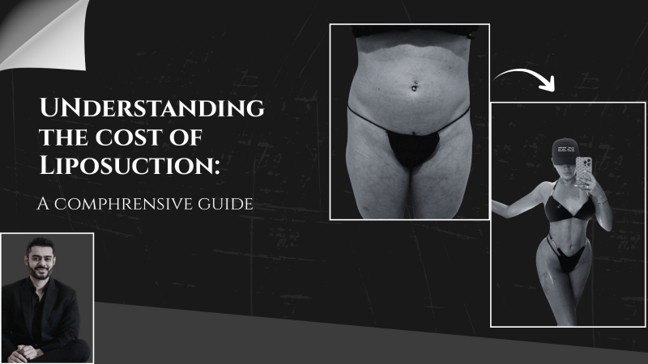
Cost of Liposuction in Dubai (2026): Prices for VASER, Lipo 360, Chin, Arms & More A clear, honest guide to what liposuction costs, why quotations differ, and what you should actually compare. AT A GLANCE Typical range: AED 12,000-50,000 (about USD 3,300-13,600) for theprocedures listed in this guideBest for: Patients comparing liposuction prices in DubaiReading time: Approximately 6 minutesImportant: A consultation is still required for an accurate quotation How much does liposuction cost in Dubai? One of the first questions almost every patient asks me is: “Doctor, how much does liposuction cost in Dubai?” It is a completely fair question. You want to know whether the treatment fits your budget before spending an hour discussing cannulas, compression garments and skin quality. The honest answer is that liposuction does not have one fixed price. A small double-chin procedure and a full VASER Lipo 360 are both called liposuction, but they are not remotely the same operation. The treatment area, operating time, anesthesia, hospital costs, technology, skin quality and whether this is your first surgery or a revision all affect the final quotation. QUICK ANSWER In Dubai, the procedures in this guide generally range from approximately AED 12,000 to AED 50,000 (around USD 3,300 to USD 13,600). Larger combination procedures, complex revision cases or additional fat transfer may cost more. Liposuction cost in Dubai by treatment area Here are practical planning ranges for the procedures patients ask about most often. The USD figures are rounded equivalents using approximately USD 1 = AED 3.67. Procedure / area Approximate AED Approximate USD Double chin liposuction AED 12,000-20,000 USD 3,300-5,500 Face and neck liposuction AED 22,000-25,000 USD 6,000-6,800 Face and neck liposuction + J-Plasma AED 25,000-30,000 USD 6,800-8,200 VASER arm liposuction AED 25,000-30,000 USD 6,800-8,200 Arm liposuction + J-Plasma AED 30,000-35,000 USD 8,200-9,500 VASER back liposuction AED 25,000-30,000 USD 6,800-8,200 Back liposuction + J-Plasma AED 30,000-35,000 USD 8,200-9,500 Thigh liposuction AED 30,000-40,000 USD 8,200-10,900 VASER Lipo 360 AED 38,000-45,000 USD 10,300-12,300 Lipo 360 + J-Plasma AED 40,000-50,000 USD 10,900-13,600 Price note: These are approximate planning ranges, not fixed quotations. Your written quotation should clarify the exact surgical plan, inclusions and any applicable VAT Why can two liposuction quotations look completely different? This is where patients understandably get confused. Two clinics may both write “abdominal liposuction”on the quotation, yet one price may be dramatically higher. But the name of the procedure tells you very little about the work involved. One plan may be a straightforward, small-area procedure under local anesthesia. Another may involve VASER, powerassisted liposuction, detailed sculpting, treatment of the flanks and back, general anesthesia, an overnight hospital stay, garments, foams and structured aftercare. Both quotations may technically say “liposuction.” They are not the same operation. Comparing only the final number is a little like comparing two hotel rooms without checking the city, the room category or whether one of them is actually a tent. SURGEON’S NOTE Do not ask only, “How much fat will you remove?” The number of litres is not a quality score. Shape, symmetry, transition zones, skin behaviour and safety matter far more than chasing a dramatic volume. What affects the cost of liposuction? Factor Why it changes the price Size and number of areas Treating the chin is very different from treating the abdomen, flanks, back and waist in one session. Operating time More extensive sculpting and careful blending require longer theatre time Type of anesthesia A small procedure may be suitable for local anesthesia or sedation; larger procedures usually require general anesthesia. Hospital and facility fees Accredited operating rooms, nursing, recovery care and overnight stay add to the total cost. Technology used VASER, PAL/MicroAire and J-Plasma are different tools with different disposables, equipment and operating-time requirements. Skin quality Good skin may retract well after fat removal. Loose skin may require J-Plasma, a mini tummy tuck or formal skin excision. Primary versus revision surgery Revision liposuction is usually more complex because previous surgery can leave scar tissue, uneven fat layers, adhesions or over-suctioned areas. Fat grafting or combination surgery Adding fat transfer, gynecomastia surgery, tummy tuck or another bodycontouring procedure changes the plan and price. A quick guide to the most-searched procedures Double chin liposuction cost in Dubai Double chin liposuction usually costs around AED 12,000-20,000 (USD 3,300-5,500). It may be performed as a focused procedure, but the price changes when the treatment extends into the jawline and neck or when skin tightening is added. The key question is not simply whether there is fat under the chin. We also need to assess the skin, the neck anatomy and whether the concern is actually caused by fat, loose skin, muscle bands or a combination. Arm liposuction cost in Dubai VASER arm liposuction is approximately AED 25,000-30,000 (USD 6,800-8,200). When J-Plasma is added for selected patients with mild-to-moderate skin laxity, the range is approximately AED 30,000- 35,000 (USD 8,200-9,500). Arms are less forgiving than many patients expect. Smoothness matters, the transition into the shoulder and axilla matters, and poor skin quality can limit the result. Removing more fat is not automatically better. Back liposuction cost in Dubai VASER back liposuction generally ranges from AED 25,000-30,000 (USD 6,800-8,200), while back liposuction with J-Plasma is approximately AED 30,000-35,000 (USD 8,200-9,500). The back is often divided into upper, middle and lower zones. Treating only one roll may be less extensive than contouring the full back and blending it into the waist. This is why phrases such as “back lipo” can mean very different things on different quotations Thigh liposuction cost in Dubai Thigh liposuction is approximately AED 30,000-40,000 (USD 8,200-10,900), depending on whether the plan includes the inner thighs, outer thighs, knees, banana rolls or multiple zones. The thighs require conservative, even contouring. Skin quality and cellulite also need to be discussed honestly because liposuction removes fat; it does not reliably erase cellulite or significantly loose skin. VASER Lipo 360 cost in Dubai VASER Lipo 360 generally costs approximately AED 38,000-45,000 (USD 10,300-12,300). When JPlasma is added, the range is approximately AED 40,000-50,000